"Now, here, you see, it takes all the running you can do, to keep in the same place. If you want to get somewhere else, you must run at least twice as fast as that!"
— The Red Queen, in Lewis Carroll's Through the Looking-Glass, 1871
By the early 1880s, electric generating stations were running in New York and London. Electric motors were on sale. And for the next forty years, American factory productivity barely moved.
The economist Paul David spent much of his career explaining why.1 Factory owners did the obvious thing. They pulled out the great central steam engine and bolted a big electric motor in its place. Everything else stayed the same: the same multi-storey building, the same line shafts and leather belts running every machine at one speed, the same layout dictated by where the power came in. They had installed the new technology inside the old organisation, and it changed almost nothing.
The payoff came only when a new generation of managers redesigned the factory around the motor: single-storey plants laid out for the flow of work, a small motor on every machine, workers trained and trusted to run their own stations. Then productivity leapt. In the 1920s, US manufacturing productivity grew by more than 5% a year.1 The value was never in the motor. It was in the redesign.
In 1987, Robert Solow made the same observation about computers: you could see the computer age everywhere except in the productivity statistics.2 It took another decade, and another round of reorganisation, for the numbers to show up.
Artificial intelligence is the next great general-purpose technology, and it carries the same lesson with one brutal difference. The dynamo of 1900 stayed roughly the same dynamo for decades. A factory could take a generation to redesign around it. Today's dynamo is replaced every few months. The redesign is never finished, because the thing you are redesigning around keeps changing underneath you.
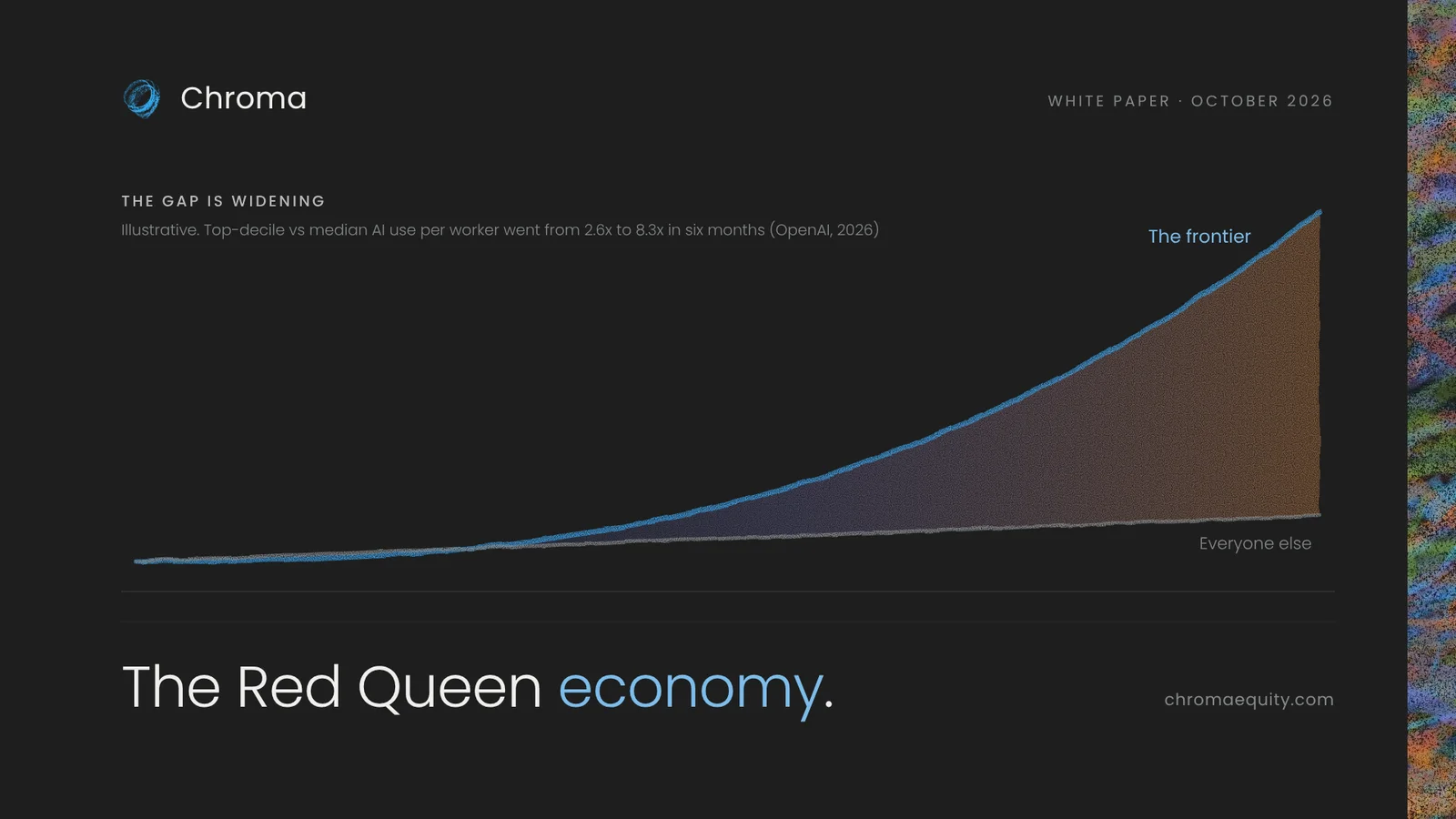
That is why the distance between the companies at the frontier and everyone else is not closing. It is widening. In January 2026, OpenAI's heaviest-using business customers produced 2.6 times as much model output per active user as the median customer. By June, the gap was 8.3 times.6 It more than tripled in six months.
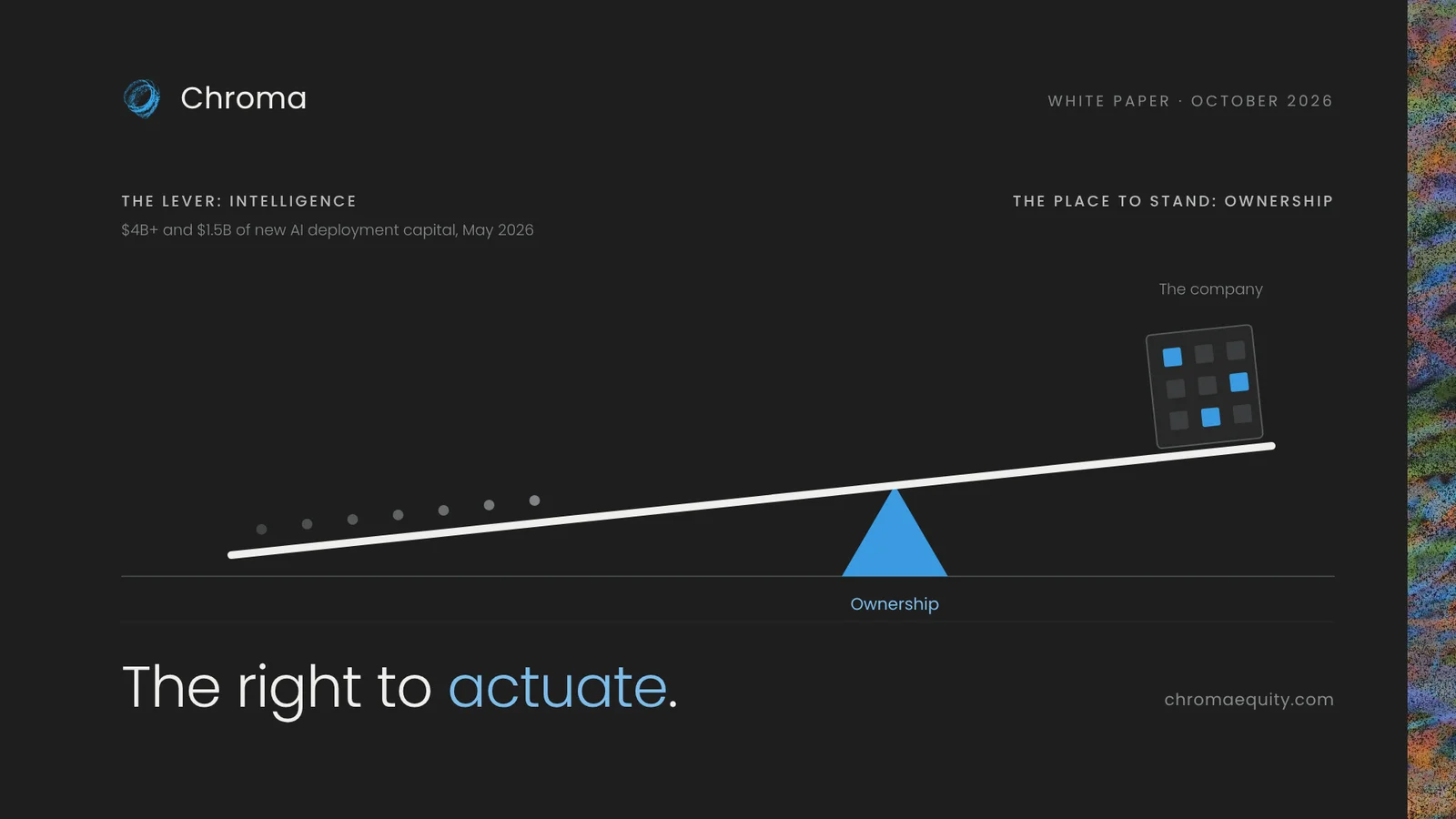
Our position. Every previous general-purpose technology eventually became a level playing field, because it stopped changing long enough for everyone to reorganise around it. AI is not stopping. Its capability is compounding roughly tenfold a year, faster than any organisation can absorb, so the gap between leaders and laggards is widening rather than closing. In this world, an AI implementation behaves like a perishable asset: it has a half-life, measured in months, after which it is working with half the capability the frontier now offers. The winners will not be the companies that implement AI. They will be the ones built to keep re-implementing it, on a schedule, forever. Almost no small company can do that alone, and most of the ways capital has tried to help, from consultants to engineers hired into a single portfolio company, are structurally designed to finish, which is precisely the wrong goal. We believe the capability has to be owned at the level of the firm: funded there, kept together there and rewarded there, on results across every company, so that each improvement is carried everywhere and nothing is ever considered done. That is the firm we are building. In the Red Queen's country, standing still is moving backwards.
I. The curve, and the half-life of an implementation
Begin with how fast the frontier is moving. Three independent measures point the same way.
| What is measured | How fast it is changing | Ref. |
|---|---|---|
| Length of task an AI agent can complete, in human working time, at 50% reliability | Doubled about every 7 months from 2019 to 2024. For 2025 models, about every 3.5 months: roughly 10x a year | 3 |
| Cost of a fixed level of capability | Running a model at GPT-3.5's level fell about 280-fold between November 2022 and October 2024 | 4 |
| Price of intelligence | Epoch estimates the minimum cost to reach a given performance level has fallen about 47% a quarter since 2023, and the unit price of intelligence about thirteenfold a year since GPT-3 | 5 |
These numbers have a consequence that most organisations have not absorbed. Every AI implementation now has a half-life.
The idea is simple. If the frontier's capability doubles every three to four months, then a system built on today's tools and left unchanged will, within about that time, be working with half the capability now available. Within a year it will be working with something like a tenth. Nothing about it broke. It simply stood still while the ground moved. This is our illustration, built on the METR rate, not a precise law, but the direction is not in doubt.
Now run the arithmetic every executive should run. A company plans an AI project, takes twelve months to deliver it, and declares the job done. At a doubling time of 3.5 to 4 months, it goes live on a design built around tools roughly eight to ten times weaker than the ones available on launch day. It finishes and falls behind at the same moment.
No budget cycle, procurement process or change-management programme was designed for a technology with a half-life of months. Most organisations plan annually. Some plan quarterly. The tool they are planning around changes faster than either.
II. The gap, and the J-curve most companies are stuck in
If everyone were keeping pace, a fast frontier would lift every company equally. The evidence says otherwise. Use of AI is nearly universal. Value from it is not.
| Signal | What it shows | Ref. |
|---|---|---|
| Adoption | 88% of organisations use AI in at least one function, up from 78% a year earlier | 7 |
| Scale | Only about a third have begun to scale it across the business | 7 |
| Value | Only about 6% are high performers attributing 5% or more of EBIT to AI | 7 |
| Pilots | About 95% of enterprise generative-AI pilots show little or no measurable P&L impact | 8 |
| Intensity | The top decile of OpenAI's enterprise customers produce 8.3x the output per active user of the median, up from 2.6x in January 2026 | 6 |
| Machinery | At those leading firms, 19% of weekly users rely on reusable skills, against 3% at typical firms | 6 |
| Small business | About 20% of US businesses used AI in May 2026, against 37% of firms with 250+ employees; use was flat among the smallest | 10 |
Why would 88% of companies use a technology and only 6% get substantial value from it? Economists have a name for the pattern. Erik Brynjolfsson, Daniel Rock and Chad Syverson call it the productivity J-curve.9 A general-purpose technology pays off only after a company makes large, mostly invisible investments around it: redesigning processes, cleaning data, retraining people, changing how decisions are made. While those investments are being made, measured productivity looks flat or even worse. The payoff comes later, on the way up the J, once the redesign is done.
This is the dynamo story in modern language, and it explains the numbers above. Most companies have bought the motor and are stuck at the bottom of the curve.
And here is the twist that matters. When the technology changes every few months, the J-curve doesn't happen once. It restarts. Every major leap in capability sends a company back down into a new round of redesign. A company that takes eighteen months to climb out of each J will spend its entire life at the bottom. A company that can climb out in a quarter gets paid, again and again. The gap between the leaders and the rest is, more than anything, a gap in how fast they can get through the J.
III. Why the gap compounds
Markets usually close gaps. Competitors copy, tools standardise, prices fall. A gap that widens needs an explanation. We see four forces working together.
Absorptive capacity. In 1990, Wesley Cohen and Daniel Levinthal showed that an organisation's ability to recognise, absorb and use new knowledge depends heavily on what it already knows.11 Learning is cumulative. A company that has already redesigned three workflows around AI knows where its data is weak, which tasks can be handed over and how to check the output. When the next model arrives, it absorbs it in weeks. A company that hasn't started cannot even evaluate what the new model makes possible. This is why OpenAI's heaviest users rely on reusable skills six times as often as typical firms.6 Their edge is not a better model. Everyone has the same models. It is the accumulated machinery around them.
The re-implementation tax. Every leap in capability means revisiting processes, data, controls and training. An organisation with a standing team and a habit of change pays that tax cheaply and often. An organisation that treats AI as a project pays it expensively, as a new initiative each time, which means it pays it rarely. The difference widens with every release.
Tempo. People who work at the frontier recalibrate what is possible every month. Most organisations recalibrate once a year, at budget time. The frontier team keeps asking what has become possible since last quarter; the rest are still evaluating last year's answer. As tools begin to help improve themselves, that difference in tempo only grows.
The law of constant extinction. In 1973, the evolutionary biologist Leigh Van Valen noticed something strange in the fossil record: within a group of species, the chance of going extinct did not fall with age. Old, established species died out at about the same rate as young ones. His explanation was that every species is in a constant arms race with the others around it, so standing still is the same as falling behind. He named it after the Red Queen.12 Corporate life increasingly looks the same. Innosight estimated that the average tenure of a company on the S&P 500 fell from 33 years in 1965 toward a forecast 14 years by 2026.13 Incumbency used to be a moat. In a Red Queen economy, age offers no protection. Only the ability to keep running does.
Put these four together and the usual pattern of technology reverses. In most cycles, time favours the followers: the leaders pay for the mistakes, and the followers adopt the finished product. In this one, time favours the leaders, because there is no finished product to adopt.
IV. "Done" is the most dangerous word
The first-level response to AI is a project. Pick the use cases, implement the tools, train the staff, declare victory. That is how organisations have absorbed every technology for fifty years, and it is exactly the wrong response to this one.
The second-level response begins from a different premise: the asset is not the implementation. The asset is the capacity to re-implement. An implementation depreciates on a half-life of months. The capacity to re-implement appreciates, because it compounds with every cycle.
In practice, a company built for the Red Queen does four things that most companies don't.
It keeps a graveyard. Every use case that failed is written down, with the reason it failed. Each time a meaningfully better model arrives, the graveyard is re-tested. Many of last year's failures are this year's wins, and the companies that find them first are the ones that remembered to look.
It holds a frontier review on a schedule, not in a crisis. Every quarter, someone asks of every core workflow: what could now be done better, cheaper or with fewer hand-offs than when we last looked?
It builds to be swapped. Clean data, documented processes and modular integrations mean the next model can be plugged in rather than rebuilt around. The first redesign is expensive. The tenth should be cheap.
It keeps a ledger. Every change is measured lever by lever, in cash: hours saved, jobs added, prices realised, invoices collected faster. Without the ledger, nobody can tell which upgrades paid off, and the organisation loses the will to do the next one.
None of this is technically hard. All of it requires someone whose job it is, permanently. And that is the problem for most of the economy.
V. The smallest runners
The Red Queen is hardest on the smallest runners, and it is worth being specific about why.
There is no one to run. A 40-person inspection, testing or field-service company has no CIO, no data team and no AI budget. The owner answers the phone at 7am and does the books at night. Even an owner who wanted to keep pace with a frontier that moves every three months has no one to do it.
They start furthest behind, and are falling further. AI use is rising among larger firms and flat among the smallest.10 Every new release widens the distance between companies that have the machinery to absorb it and companies that don't.
They are changing hands. About 6 million US small businesses face an ownership exit by 2035, more than a million of them viable for sale.14 Whoever buys them decides whether they join the race or drop out of it.
And yet these companies have more to gain than anyone. They start from zero, so the first improvements are the largest. The work AI does best, answering calls, quoting, scheduling, invoicing and chasing payment, is exactly the work that consumes their owners' days. And the price of intelligence keeps falling.45
The history of electricity offers a warning here. The motor's arrival did not lift every factory. The gains went to the factories that redesigned around it, not to those that merely installed it. What these businesses lack today is not access to the technology. It is someone who will keep carrying it in, every quarter, for as long as they own the business.
VI. Where the capability must live
In 1975, the management scholar Steven Kerr published a paper with one of the best titles in business literature: On the Folly of Rewarding A, While Hoping for B.15 His point was simple and still widely ignored. Organisations say they want one behaviour and pay for another, then act surprised when they get what they paid for.
Apply Kerr's test to the ways capital currently tries to bring AI into the companies it owns.
| Where the capability sits | Who pays | What it is rewarded for | What happens when a better model ships | Is the learning carried to the next company? |
|---|---|---|---|---|
| A consultancy or deployment firm | The company, per engagement | Finishing the engagement | A new engagement has to be sold | Rarely; the team moves to the next client |
| An engineer hired into one portfolio company | The company, as salary | One company's project, often a one-time build | Depends on one isolated person keeping up alone | No; stranded inside one business |
| A traditional operating-partner group | Often the company, through fees | Advice, and fund-level returns | Advice, if someone asks | Partly, as advice rather than build |
| An engineering team owned and rewarded by the firm | The firm, not the company | Results across every company, realised in cash and at exit | Re-deployed across every company on a schedule | Yes; every company teaches the next |
The first three models reward A, finishing, while hoping for B, continuous re-implementation. In a world where implementations depreciate on a half-life of months, finishing is the wrong goal. Only the fourth model pays for the behaviour the Red Queen demands.
We think the case for firm-level ownership rests on four arguments.
The economics of amortisation. A company earning $3M a year cannot fund a frontier engineering team, and certainly cannot afford to rebuild its systems every time the models improve. A firm can, because it spreads the cost of each upgrade across every company it owns. The second company's pricing project reuses the first one's data. The tenth reuses the first nine. The re-implementation tax, crushing for a single small company, becomes a modest line item for a firm.
The physics of talent. Engineers who work at the frontier stay at the frontier by working with other engineers who do. Placed alone inside a 40-person business, the best of them lose touch with the state of the art within months, which is precisely the decay the curve punishes. Kept together at the firm, they sharpen each other and see the problems of every company at once.
The direction of incentives. An engineer paid by one company to deliver one project is rewarded for finishing. An engineer rewarded at the firm level, on results across every company and over the full holding period, is rewarded for going back to last year's work and upgrading it, and for carrying a breakthrough from one company to all the others. The Commanding Heights argues that in the new economy, the people who really drive results will be paid and governed like capital.5 We agree, and we think that principle belongs inside the firm, not just at the top of it.
The precedent. This is not a new idea, only a newly urgent one. Danaher built one of the great compounding records in American business, with earnings per share up roughly a hundredfold from 1990 to 2023, by owning a single operating system, the Danaher Business System, at the level of the firm and applying it to every company it bought.16 The system belonged to the parent, improved with every acquisition, and was carried into each new business. The capability we are describing is the same idea, rebuilt for a technology that changes every quarter rather than every decade.
The conclusion is simple to state. In a world where implementations depreciate, the capability to re-implement is the asset. It should be owned by the institution that holds every company, and the people who exercise it should be paid on the results of all of them.
VII. What this means for investors
For an investor in private companies, the Red Queen changes what is being bought.
The old question was "what is the company worth?" The new question is "how fast can its owner make it better, and keep making it better?" Two identical businesses, bought at the same price, will diverge sharply depending on whether their owner can climb out of each new J-curve in a quarter or in two years. In a Red Queen economy, the owner's capability is part of the asset.
That capability compounds at the level of the manager, not the deal. Every company a firm rebuilds teaches it something it can use in the next. A manager with a standing, well-rewarded engineering team should get better and faster with every company. A manager that rents its capability from consultants starts from zero each time. The difference shows up not in any single deal but across the life of a fund, and across funds.
It also changes how leverage looks. Re-implementation costs money every year and takes quarters to pay back. A company carrying heavy debt must spend its cash on interest first, and will skip the upgrade it cannot afford. In a market where a typical leveraged buyout already needs 10–12% annual EBITDA growth to earn 2.5x,17 debt does not just add financial risk. It slows the runner.
We would suggest three questions for every manager pitching an AI-enabled strategy. Where does the AI capability in your portfolio actually live? Who pays for it? And what, exactly, are those people rewarded for?
VIII. How Chroma is built to keep running
We designed Chroma on the assumption that the frontier will keep moving faster than any single company can follow. Our answers to those three questions are the firm.
Where the capability lives: at the firm. Our engineers are Chroma's, not the portfolio company's. They work inside each business we own, side by side with its people, and they stay together as one team across every company.
Who pays: the firm. Portfolio companies are not charged for our engineers. Owners and investors are not paying twice for the same help.
What they are rewarded for: results across everything we own. We are designing engineering compensation to sit at the firm level, tied to lever-by-lever results across all our companies and to realised value at exit, rather than to finishing any one project.
A cadence, not a project. Every company gets a standing frontier review and a graveyard of past failures that is re-tested as the models improve, so nothing we build is ever considered finished.
Systems and data first. The first thing we build in every company is one clean data layer, so the next model can be plugged in rather than rebuilt around.
A partner bench that upgrades itself. Our vertical AI partners each own one job: answering the phone, selling, billing, collecting. Each ships improvements continuously, and every company we own receives them. That fits MIT's finding that partnering with specialised vendors succeeds about three times as often as building internally.8 These partnerships are in discussion; none has been signed.
One company at a time, with little or no debt. A team spread across too many companies cannot re-implement anywhere, and a company servicing heavy debt cannot afford to keep upgrading. Depth and patience are what let us keep running.
What would prove us wrong
The curve flattens. If progress slows, the tools will standardise, followers will catch up and the value of continuous re-implementation will shrink. We would still own good businesses bought at sensible prices, but this particular edge would narrow. We would welcome finding out.
AI learns to deploy itself. If agents become able to install and upgrade themselves inside an old business with little human help, the scarce skill disappears. We think the physical, regulated, relationship-heavy companies we buy will be among the last places this happens, but we are watching for it.
The central team becomes a bottleneck. A firm-level team can drift too far from the work. We guard against that by embedding engineers inside each company and keeping the number of companies small.
The incentive drifts. Engineers rewarded at the firm level could come to favour impressive projects over profitable ones. The ledger, every change measured in cash, is how we keep the incentive honest.
Each of these would show up early, company by company, rather than at the end of a fund.
Our recommendation
For allocators: ask every manager the three questions. If the AI capability in a portfolio lives with a consultant, a one-off project or an engineer stranded inside a single company, the portfolio is buying an asset with a half-life of months. Back the managers who own the capability, pay for it themselves and reward it on results across every company.
For owners: almost every buyer will tell you they will bring AI to your business. Ask a different question: who will still be upgrading it two years after closing, and what are they paid to do?
For ourselves: a small number of companies, a standing cadence of re-implementation, and a ledger that shows, every quarter, what changed and what it was worth.
It took American factories forty years to learn that the value of electricity was in redesigning the factory, not in installing the motor. Those that learned it first pulled ahead.
This time, the motor changes every few months. The redesign is never finished. The gap between those who keep redesigning and those who stop is widening every quarter, and Van Valen's fossils tell us that age and size offer no protection.
Most companies will try to implement AI. The ones that win will be built to keep implementing it.
The Red Queen was right: it takes all the running you can do to stay in the same place. We did not build a firm that has implemented AI. We built one that never stops.
— Chroma Partners