"Because the purpose of business is to create a customer, the business enterprise has two, and only two, basic functions: marketing and innovation."
— Peter Drucker, The Practice of Management, 1954
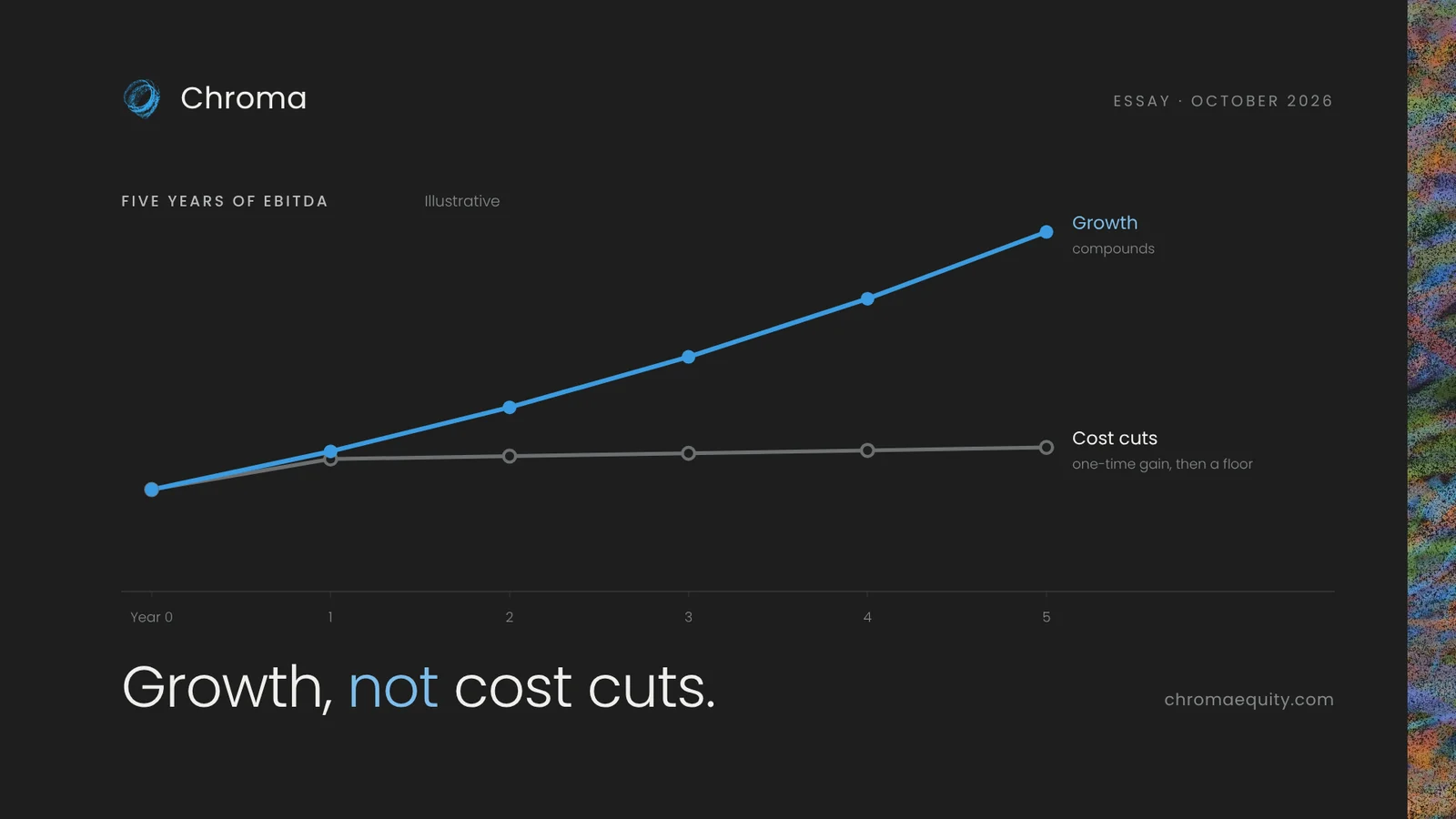
Our position. The standard buyout playbook opens with one question: what can we cut? In a lean, owner-run business, that question has a low ceiling and a high cost. The arithmetic of today's market demands 10–12% EBITDA growth a year, and no business cuts its way there for long. We believe the larger and safer prize in small companies is the revenue they have never been organised to earn: a salesperson, a real price list, a service contract and a system that remembers what the owner knows. Cost discipline is the floor of our plan. Growth is the plan.
Go looking for the fat
Walk into a 40-person inspection company and try to find the fat. You won't find much. The owner answers the phone at 7am. The office manager does payroll, billing and HR. The best technician also trains the new hires. There is no VP of anything.
That is what most small businesses look like. They are lean because they have had to be. And yet the playbook for buying one still starts with the scissors.
The old playbook ran on cheap money
For about a decade, buyouts could earn good returns without changing much. Debt was cheap and valuations kept rising. Buy a company, borrow against it, trim some costs and sell it a few years later at a higher multiple.
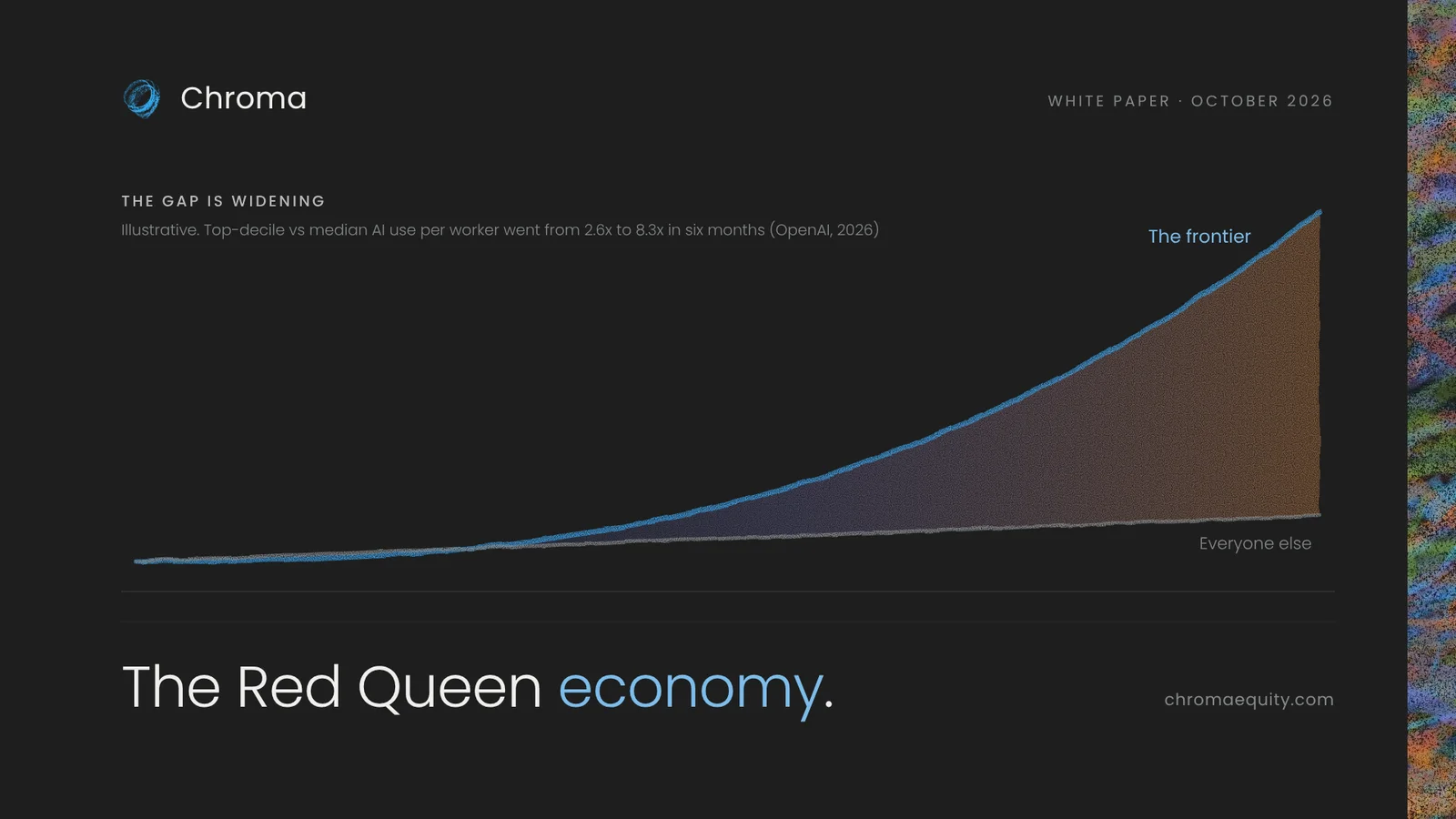
That world is gone. In the 2010s, a typical deal needed about 5% EBITDA growth a year to return 2.5x over five years. With higher rates, less debt and record entry prices, it now needs 10–12%.1 Bain sums it up as "12 is the new 5".
You cannot cut your way to 12% a year. Not for long, and certainly not in a business that is already lean. A cut is a one-time gain with a hard floor. Growth compounds.
Cuts break the things customers pay for
In a small business, "overhead" is often the reason customers stay. It is the dispatcher who knows which client wants a call before the truck arrives. It is the technician who has serviced the same hospital for fifteen years and knows where every valve is.
Cut too close and you don't get a leaner company. You get a fragile one, and the customers notice before the owner does.
Where the growth is hiding
Most of the small businesses we meet share the same four gaps. None of them is about cost.
Nobody sells. Work comes in through referrals and the owner's phone. No one's job is to find the next customer, follow up on a quote or win back the one who drifted away.
Prices haven't moved. Many owners haven't raised prices in years, out of loyalty or habit. That is generous, and it is expensive. McKinsey found that for a typical S&P 1500 company, a 1% price increase lifts operating profit by about 8%. That is roughly 50% more than a 1% cut in variable cost, and more than three times a 1% rise in volume.3 Berkshire Hathaway's purchase of See's Candies is the classic illustration. Bought in 1972 for $25M, when it earned under $5M before tax, See's produced $82M of pre-tax profit in 2007 on $383M of sales, and $1.35B of cumulative pre-tax earnings, while needing only $32M of additional capital.4 A business with pricing power does not need much else.
Every job is a one-off. The company inspects, fixes or builds something, sends an invoice and waits for the next call. A service contract turns that into revenue you can count on, and it gives customers something they usually want anyway.
The data lives in one person's head. Which customers are profitable? Which quotes never got a follow-up? The owner knows some of it. The systems know almost none of it.
What closing the gaps is worth
A simple example shows the leverage. Take a company with $20M of revenue and a 15% EBITDA margin, so $3M of EBITDA. A 3% price increase that keeps every customer adds $0.6M of EBITDA, a 20% gain, without hiring anyone or cutting anyone. That is our illustration, not a forecast, and in practice some customers will push back. But the direction of the arithmetic is hard to argue with.
The gain also compounds through the multiple. Buyers pay more for bigger, more predictable companies. In the first half of 2025, PE-backed deals under $25M of enterprise value averaged about 6.3–6.9x EBITDA. Deals of $100–250M averaged 10.0x.5 A company that grows into the next band is paid for its higher earnings and again for the higher multiple on them.
AI should sell, not just cut
The AI conversation in private equity is mostly about cost: automate the back office and shrink the headcount. That will happen, and it should. But it is table stakes. Every buyer will automate invoicing, and every seller will price that in.
The bigger opportunity is the top line. Answer every call, including the ones at 7pm. Follow up on every quote within the hour. Price every job the same way, from real data. Spot the customer who is about to leave before they do. Bain's own midyear update makes the same point: treat AI as a revenue and workflow tool, not only a way to cut costs.2
The hard part isn't the technology. It is getting it to work inside a 30-year-old business with old software, paper habits and customers who don't want to be "transformed". That takes people who show up and do the work.
What could go wrong
Price increases can lose customers. We test price changes on segments before rolling them out, and we start with the work that has been most underpriced for longest.
The first salesperson can fail. Many small companies have hired one and given up. We give that hire a system, a pipeline and a quota built from real data, rather than a phone and a hope.
Change can break the culture. Systems come before sales, and every change is agreed in writing with the owner before we sign.
Growth takes longer than cuts. It does. That is why we use little or no debt: a company that isn't servicing a loan can afford to wait two quarters for its investment to pay back.
How Chroma is built for this
We designed the firm around growth, not cuts.
Engineers, not consultants. Our own team works inside every company we own. We build the systems, the data and the sales engine, and we don't bill the company for it.
A bench of AI partners. We are building partnerships with vertical AI companies, one for each job: the front office, field sales, collections and finance. Our engineers make their tools work inside each business. These partnerships are in discussion; none has been signed.
Little or no debt. A company that isn't servicing heavy debt can afford to invest in its first salesperson. A bad year stays a bad year.
One company at a time. No roll-ups. We would rather know one business deeply than run dozens from a spreadsheet.
A plan written down first. Before anyone signs, the owner knows what we will change and what we won't.
The question we ask instead
Not "what can we cut?" but "what has this business never been given?"
Usually the answer is a salesperson, a price list, a service contract and a system that remembers what the owner knows. That isn't a diet. It's a growth plan, and we think it is the better investment.
— Chroma Partners