"If something cannot go on forever, it will stop."
— Herbert Stein, economist and former Chairman of the Council of Economic Advisers
Our position. For thirty years, falling rates and rising multiples did a great deal of private equity's work. That tide has gone out. Returns now have to be earned the old-fashioned way, by making companies better, and mostly by helping them grow. We believe that work is cheapest to buy, hardest to do and best paid in businesses earning $1–10M of EBITDA. Chroma is built to do it: one company at a time, majority ownership, little or no debt, and our own engineers inside every business we own. We call it small-cap transformation equity. It is a strategy for the market we are actually in, not the one we would like to have.
What everybody already knows
Start with what is not in dispute. In the 2010s, a typical buyout needed about 5% annual EBITDA growth to return 2.5x over five years. Today it needs 10–12%.1 Borrowing costs of 8–9%, leverage of 30–40% and record entry prices have left little for financial engineering to do. Bain's shorthand is "12 is the new 5".1
The symptoms show up in every LP report:
| Signal | Figure | Ref. |
|---|---|---|
| Unsold PE-backed companies | About 32,000, worth $3.8T | 1 |
| Typical hold at exit | About 7 years, up from 5–6 in 2010–2021 | 1 |
| Distributions as a share of NAV | About 14%, the lowest since 2008–09 | 1 |
| PE against public markets | Public markets won in most periods shorter than 10 years | 2 |
| LPs cutting buyout exposure | About 1 in 5 | 3 |
None of this is a secret. Bain's prescription in both of its 2026 reports is the same: more operational improvement, more revenue growth, and AI treated as a tool for revenue and workflow, not only for cutting cost.13 Every firm has read it. That is precisely why reading it is not an edge.
What we think the market is missing
Knowing that value creation has to change is first-level thinking. The second-level question is where that work is cheapest to buy and most likely to pay, and who is actually equipped to do it. Our answer is the bottom of the market, for five reasons.
Price. In the first half of 2025, PE-backed deals under $25M of enterprise value averaged 6.3–6.9x EBITDA. Deals of $100–250M averaged 10.0x.4 A company that grows from the first band into the second gets paid twice: once for higher earnings, and again for a higher multiple on those earnings. No amount of leverage can manufacture that second payment.
Sellers. About half of US employer businesses are owned by someone 55 or older.5 Baby-boomer owners hold roughly 2.3 million businesses employing 24.7 million people.6 In a 2024 Gallup survey, 27% of owners with employees either planned to close or did not know what would happen to their business.7 That is a seller with a reason to sell and, often, no obvious buyer.
Competition. Capital is pooling at the top. Funds of $500M or more took about 81% of LP dollars raised in 2025.8 A $3B fund cannot write $15M checks at scale, so the smallest good businesses are left to individual buyers, search funds and a thin layer of small sponsors.
Results, and the spread of results. Lower-middle-market buyout funds from 2010–2020 vintages earned a median net IRR of 16.1%, against 14.2% for large funds.8 MSCI data also shows that small funds have the widest gap between top and bottom quartiles.9 We read that as a market that pays well for skill and charges heavily for the lack of it. A skilled operator should want exactly that market.
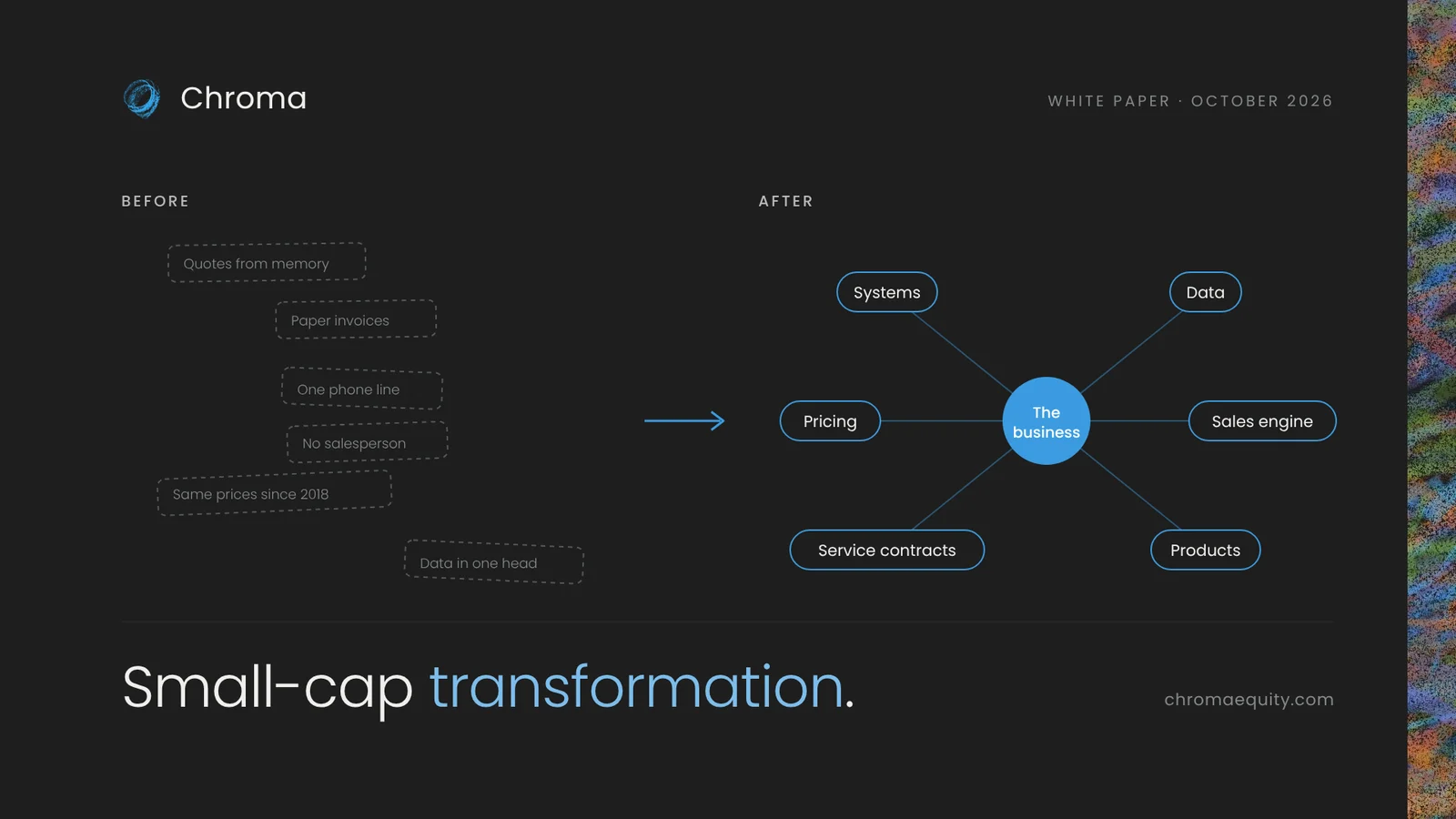
Room to improve. Most of these companies have never had a salesperson, a structured price increase, a service contract, or one system that holds their customer data. They are not broken. They have simply never been given the tools.
Why we lead with growth, not cuts
The industry's reflex on buying a company is to ask what it can cut. In a 40-person business, that is usually the wrong question.
The fat isn't there. A company that size rarely has spare layers of management. The owner, an office manager and a few senior technicians carry most of the load, and they are often the reason customers stay.
Price is the strongest lever. McKinsey found that for a typical S&P 1500 company, a 1% price increase lifts operating profit by about 8%. That is roughly 50% more than a 1% cut in variable cost, and more than three times a 1% rise in volume.10 Many small owners have not repriced in years, out of loyalty or habit.
Predictability is worth paying for. Turning one-off jobs into service contracts makes revenue predictable, and buyers pay higher multiples for predictable companies.
The arithmetic requires it. At 10–12% a year, a one-time cost cut buys perhaps a year. Only a sales engine compounds.
Cost still matters. Every company we own will run on modern systems, and that saves money. But savings are the floor of the plan, not the plan.
How Chroma does the work
We buy established, profitable businesses with $1–10M of EBITDA, take majority ownership with little or no debt, and spend the first 12–18 months building what they were never given.
| What we do | |
|---|---|
| What we buy | Testing and inspection, industrial and field services, specialty manufacturing and vertical software. Sound businesses with loyal customers, not turnarounds. |
| How we buy | Directly from owners, rarely through auctions. A free half-day working session before any offer. A price set in the letter of intent and held. What changes and what stays is written down before signing, and owners can keep a stake. |
| What we build | Systems and data first, then monthly reporting in days, then recurring products built with customers, then a sales engine that doesn't depend on the founder. |
| Who builds it | Our own engineers, inside the company. No consultants, and no fees charged to the company. |
| How we hold | One company at a time, no roll-ups. Without heavy debt, a company can pay out cash before any sale. |
A bench of AI partners. Large buyout firms partner with frontier AI labs. A $5M-EBITDA business needs something more practical: the phone answered, the upsell closed, the invoice collected. We are building a bench of vertical AI companies, one for each business function, that deploy into every company we buy. Our engineers connect their tools to one data layer, and partners share in the value they help create. To be clear about where this stands: partnerships are in discussion, and none has been signed.
Why us, and not the obvious alternatives
Most capital is built for a different job. Each type of buyer is good at something. None is set up for growth-led change inside a $1–10M business.
| Buyer | Strength | What it lacks at $1–10M of EBITDA |
|---|---|---|
| Large and mid-market PE | Capital, process and networks | Can't write small checks at scale. A leverage-led model. Consultants rather than builders. |
| AI holding companies and AI-focused funds | Engineering depth | Usually target much larger companies, or run one platform across many acquisitions. |
| Search funds and individual buyers | Founder-level attention | One operator, often first-time. Often heavy SBA debt. No engineering team. |
| Strategic acquirers and roll-ups | Synergies | Integrate and consolidate, so the company stops being its own business. |
| Chroma | In-house engineers, owner-level attention, little or no debt | Built for this segment from the start. |
Three design choices matter most. Little or no debt buys patience: a company that isn't servicing a loan can fund its first salesperson and survive a bad year, and growth investments pay back in quarters, not weeks. Builders, not advisers: change in a 30-year-old business fails at implementation, not strategy, so our engineers are there every day. One company at a time: depth beats breadth in this segment. We would rather know one business well enough to grow it than run many from a dashboard.
What could go wrong
We would rather name our risks than have you find them.
| Risk | How we address it |
|---|---|
| The owner leaves and takes the relationships | An optional rollover stake. A transition plan written before signing. Customer knowledge moved into systems early. |
| Change breaks what made the business work | Systems before sales. Changes agreed in writing up front and introduced in stages. |
| Concentration: one company at a time | Little or no debt, so a bad year stays a bad year. |
| Sourcing without auctions is slow | Direct owner outreach, a free first session and a defined set of sectors. Patience is part of the model. |
| AI partners don't deliver | Partners are rewarded only for delivered results. Our engineers can build or swap tools themselves, and no company depends on one vendor. |
| Exits from small companies | Growth moves a company into larger, higher-multiple buyer pools, and cash yield along the way lowers dependence on the exit. |
What we don't know
We don't know how fast AI tools will mature, whether search-fund pricing will creep up toward ours, or how long the exit backlog will last. We have not tried to predict those things. We have tried to build a firm that doesn't need to: no debt that forces our hand, cash yield that pays us to wait, and evidence that arrives deal by deal rather than at the end of a fund.
Our recommendation
For an allocator, the conclusion is straightforward. The returns of the last cycle were largely a gift from the market. The returns of this one will have to be built, and the place they are cheapest to build is where large capital cannot go. Near term, we will do a small number of companies, each with a written plan and results reported lever by lever. Medium term, we will raise a fund only once those results show the playbook works.
The era of cheap money could not go on forever, and it has stopped. We intend to be built for what comes next.
— Chroma Partners