"Any intelligent fool can make things bigger, more complex, and more violent. It takes a touch of genius, and a lot of courage, to move in the opposite direction."
— E.F. Schumacher
Our position. Private equity spent forty years learning that bigger is better. For the next decade, we think that lesson is wrong. Three beliefs run the industry: scale wins, roll-ups create value, and AI threatens small companies. The evidence now points the other way on all three. Scale has become a liability. The roll-up is dead, but the compounder is not. And AI makes small companies more valuable, not less. Put those together and the next great compounder won't look like a mega-fund. It will look like a disciplined owner of many small companies, with its own engineers, no dependence on debt, and a playbook that gets better with every deal. That is what Chroma is building.
Heresy one: scale is now a liability
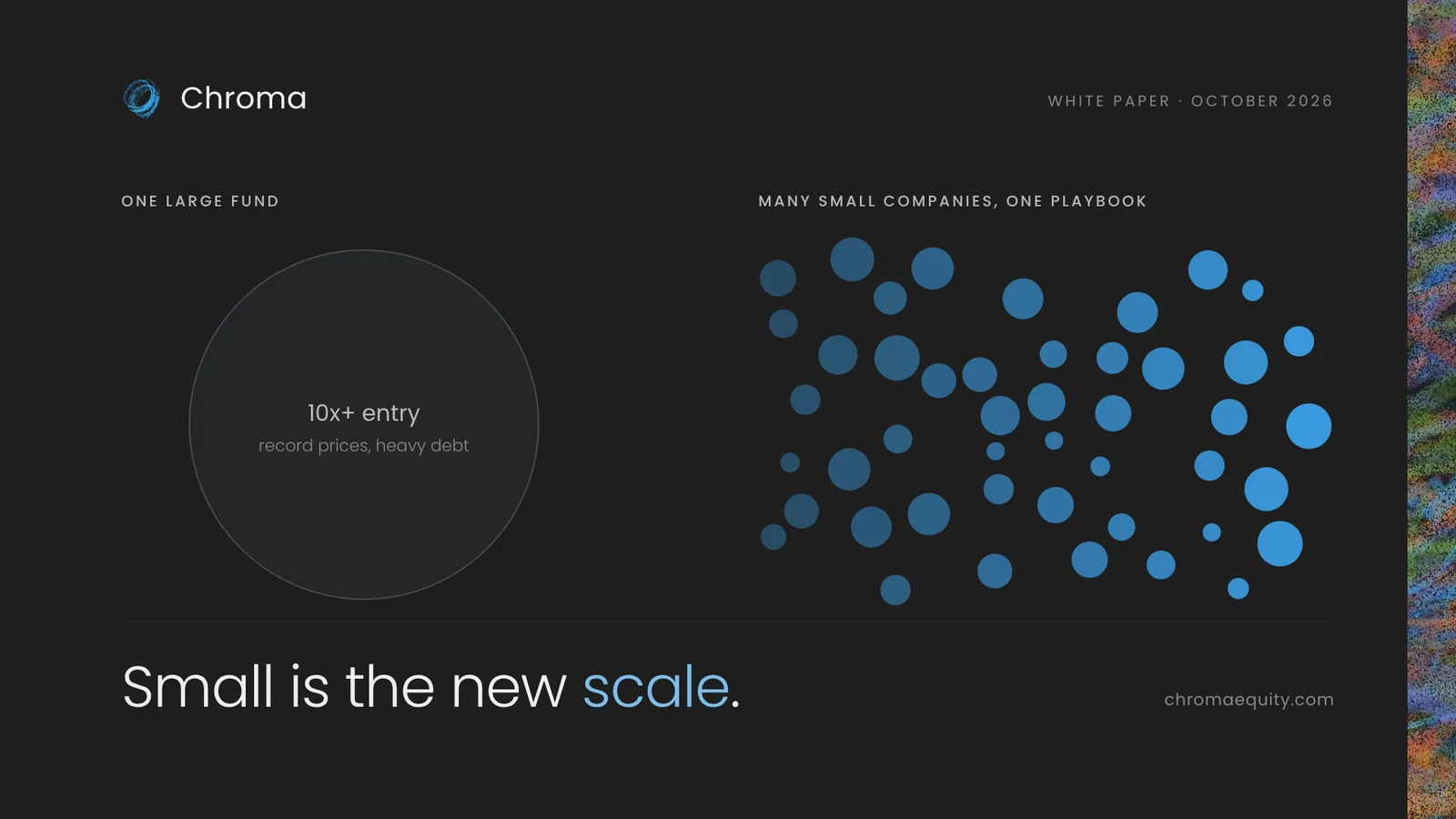
The bigger a buyout fund gets, the further it is pushed from where the returns are.
It has to pay more. PE-backed deals of $100–250M averaged 10.0x EBITDA in the first half of 2025, against 6.3–6.9x under $25M.1 A $5B fund can't put money to work at 6x.
Its returns are lower. Lower-middle-market buyout funds from 2010–2020 vintages earned a median net IRR of 16.1%, against 14.2% for large funds.2 MSCI data shows small funds beating mid and large funds at the median and top quartile "by a material margin".3
It needs more from each company. With 8–9% borrowing costs and record entry prices, a typical buyout now needs 10–12% EBITDA growth a year to reach 2.5x.4 The biggest funds pay the highest prices for the companies with the least room left to improve.
It is stuck. About 32,000 PE-backed companies worth $3.8T are unsold,4 and more than $860B of US buyout value sits in funds over seven years old.5
And yet in 2025, funds of $500M or more took about 81% of LP dollars.2 Capital is flowing toward size at exactly the moment size stopped paying. We think that is the single biggest mispricing in private markets today, and it is the opening for a firm built to be small on purpose. As Warren Buffett once put it, "It's a huge structural advantage not to have a lot of money."
Heresy two: the roll-up is dead, and the compounder isn't
Buying many small companies is one of the best strategies in business. Rolling them up with debt is one of the worst. People confuse the two because they look alike from the outside.
The evidence that repeated small acquisitions work is strong. McKinsey's study of the world's 1,000 largest companies found that "programmatic" acquirers, those doing several small or midsize deals a year, earned higher excess shareholder returns from 2007 to 2017 than companies relying on big deals, selective deals or organic growth. The more deals they did, the more likely they were to outperform.6
The best of them compounded for decades:
| Compounder | The model | Record | Ref. |
|---|---|---|---|
| Constellation Software | Small vertical-software businesses, most under $5M, held forever | 500+ acquisitions. About 30% a year compounded since its 2006 IPO | 7 |
| Lifco | Niche industrial leaders, run decentrally | 275 companies. EBITA up about 17.8% a year, 2006–2025, at a 22.4% margin | 8 |
| Judges Scientific | Small instrument makers bought at about 5x EBIT | 25%+ subsidiary margins. About 8% organic growth a year for 17 years | 9 |
| Danaher | One operating system applied to every acquisition | EPS up roughly 100-fold, 1990–2023 | 10 |
The failures share a different recipe: debt, speed and integration. The 1990s funeral-home consolidators borrowed to outbid each other and ended in Chapter 11.11 Envision Healthcare filed with about $7.7B of debt five years after KKR's $9.8B buyout.12 Across more than 10 million UK company-years, higher leverage made failure significantly more likely, buyout or not.13
Our position: the roll-up's mistake was never buying small companies. It was treating them as inventory to be merged and refinanced, rather than as businesses to be improved and kept.
Heresy three: AI makes small companies more valuable
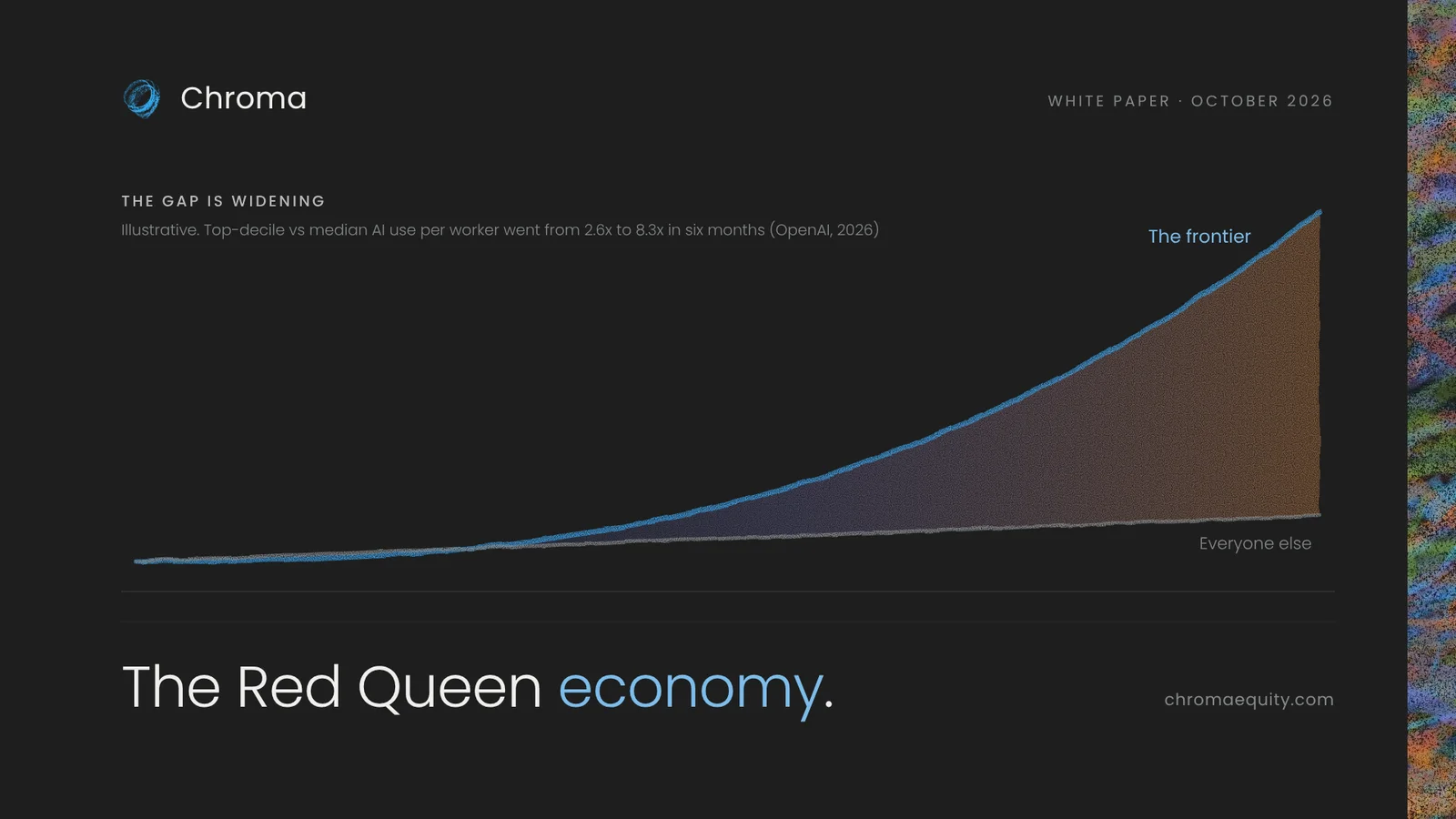
The popular story is that AI threatens small businesses. We think it is the opposite. AI is the first technology that is cheaper to deploy in a small company than a large one, and almost nobody is deploying it there.
Intelligence got cheap. The cost of running a model at GPT-3.5's level fell about 280-fold between November 2022 and October 2024.14
Small firms aren't using it. About 20% of US businesses used AI in May 2026, against 37% of firms with 250+ employees and 32% of those with 100–249. Use was flat among smaller firms.15
The work it does best is the work small firms drown in. Answering phones, quoting, scheduling, invoicing and chasing payment. In a 40-person business, the owner and an office manager do all of it. General Catalyst estimates that AI can automate 30–50% of tasks in services businesses. That is their claim, not ours, and we treat it as an upper bound.16
The hard part is installation, not invention. Large companies have IT departments. A 40-person business has none, and that is why the adoption gap exists.
The businesses most at risk from AI are the ones selling software and white-collar labour, where well-funded competitors are automating the product itself. The businesses most helped by AI are the physical, regulated, relationship-heavy ones whose product AI can't replace, but whose overhead it can transform. That second group is where we invest.
The arithmetic of a compounder at $1–10M of EBITDA
The 2.5x that a large buyout now struggles to reach with leverage, a small unlevered deal can approach on modest growth.
| Typical large buyout today | Chroma base case (illustrative) | |
|---|---|---|
| Entry multiple | Record highs, about 10x+ at $100M+ deal size | 4.5x ($9.0M for $2.0M of EBITDA) |
| Debt at entry | 30–40% of the price, at 8–9% interest | None (2.0x maximum) |
| EBITDA growth needed | 10–12% a year for 2.5x over five years | About 12–15% a year, reaching +75% over 4–5 years |
| Where the growth comes from | Operational improvement on already-professional companies | Pricing, systems, sales and recurring revenue in companies that never had them |
| Exit multiple assumed | Flat | 6.0x, the normal rate for a $10–25M deal |
| Cash before exit | Mostly goes to the lender | About $3.6M of cumulative cash yield |
| Gross multiple | 2.5x target | About 2.3–2.4x, unlevered, before fees |
Large-buyout figures from Bain, 2026.4 Chroma figures are an illustrative underwriting case, not a forecast or a track record.
The headline numbers look similar. The risk does not. The large buyout is levered, paid a record price and needs everything to go right. The Chroma case is unlevered, bought at 4.5x, and gets more than half of its gain from cash yield and from moving into a higher size band rather than from heroic growth. Benjamin Graham called it a margin of safety, and Buffett built a career on it: the protection comes from what you pay, and we intend to pay little.
Then compounding begins. Every company we rebuild should make the next one cheaper and faster: the second pricing project borrows the first one's data, and the fifth systems migration reuses the first four. Constellation and Danaher show what that looks like over decades. A firm is a compounder when its hundredth deal is easier than its first.
What a dominant firm looks like
Nobody will dominate this market by share. More than a million viable small businesses, worth about $5.1 trillion, will change hands by 2035.17 The dominant firm will be the one with the best answers to three questions: whom owners trust, who builds best, and who can do it without debt.
| What wins | How Chroma is built for it |
|---|---|
| The owner's trust | Direct conversations, a free working session before any offer, a price held from LOI to close, and a stake in what comes next |
| Building, not owning | Our own engineers inside every company, plus a bench of vertical AI partners for each business function |
| A playbook that compounds | One system applied every time, with results tracked lever by lever so each deal teaches the next |
| Discipline about debt | Little or none. Returns from growth and cash yield |
| The right size, permanently | $1–10M of EBITDA, where prices are lowest and improvement is largest |
| Two doors | Founder successions, plus the fund-owned orphans that big sponsors and venture firms can't sell |
The compounders we admire got where they are by being the best home for small businesses others ignored. Our bet is that the next one will be that home for American industrial and service businesses, and will add something the old compounders never had: engineers carrying modern software and AI into every company it owns.
What would prove us wrong
A thesis worth holding should say how it could fail. Ours fails if:
Our pilots don't show it. If our first engineering pilots can't show EBITDA gains lever by lever, the transformation story is just a story.
Good small companies reprice to 7x or more. Search funds already pay about 7x. If that becomes the norm for the companies we want, our price advantage narrows.
AI tools commoditise the work. If installing AI in a small business becomes as easy as buying software, the edge moves to sourcing and price alone.
We can't hire builders. Engineers who have rebuilt real businesses are scarce. If they won't join, the model doesn't run.
Owners don't choose us. If founders keep selling in auctions to the highest bidder, the non-auction edge disappears.
We have designed the firm so that each of these shows up early, deal by deal, rather than at the end of a fund.
Our recommendation
The industry is still paying up for size, and we think it will look back on this as the moment size stopped working. We would rather be small on purpose, cheap on entry and patient on exit. Ask us again after our hundredth company.
— Chroma Partners