"A computer can never be held accountable. Therefore a computer must never make a management decision."
— IBM training slide, 19792
The Commanding Heights opens with a man named Ravi.1 He works in Bangalore, approving and rejecting the output of AI agents that keep the books for American insurers. One morning his keycard stops working. A machine-drafted letter tells him his job has moved to "the agentic services tier." He had spent months, without knowing it, training his replacement.
A few chapters later, the authors mention a second person. She is a staff accountant in Phoenix who did much the same work as Ravi for five times the pay, and she keeps her job after he loses his.1 Not because she is faster or cheaper. Because she is licensed, and the law requires a licensed person to stand behind the numbers.
She is the most important person in the essay, and the authors give her a single paragraph. This memo is about her, and about the hundreds of thousands like her who don't sit at desks: the fire-alarm technician who certifies that a hospital's system will wake every patient, the elevator inspector, the crew that tests a switchgear before a data centre is energised. A model can do more of their work every month. It cannot do the one thing their customers are legally required to buy. It cannot put its name on the result.
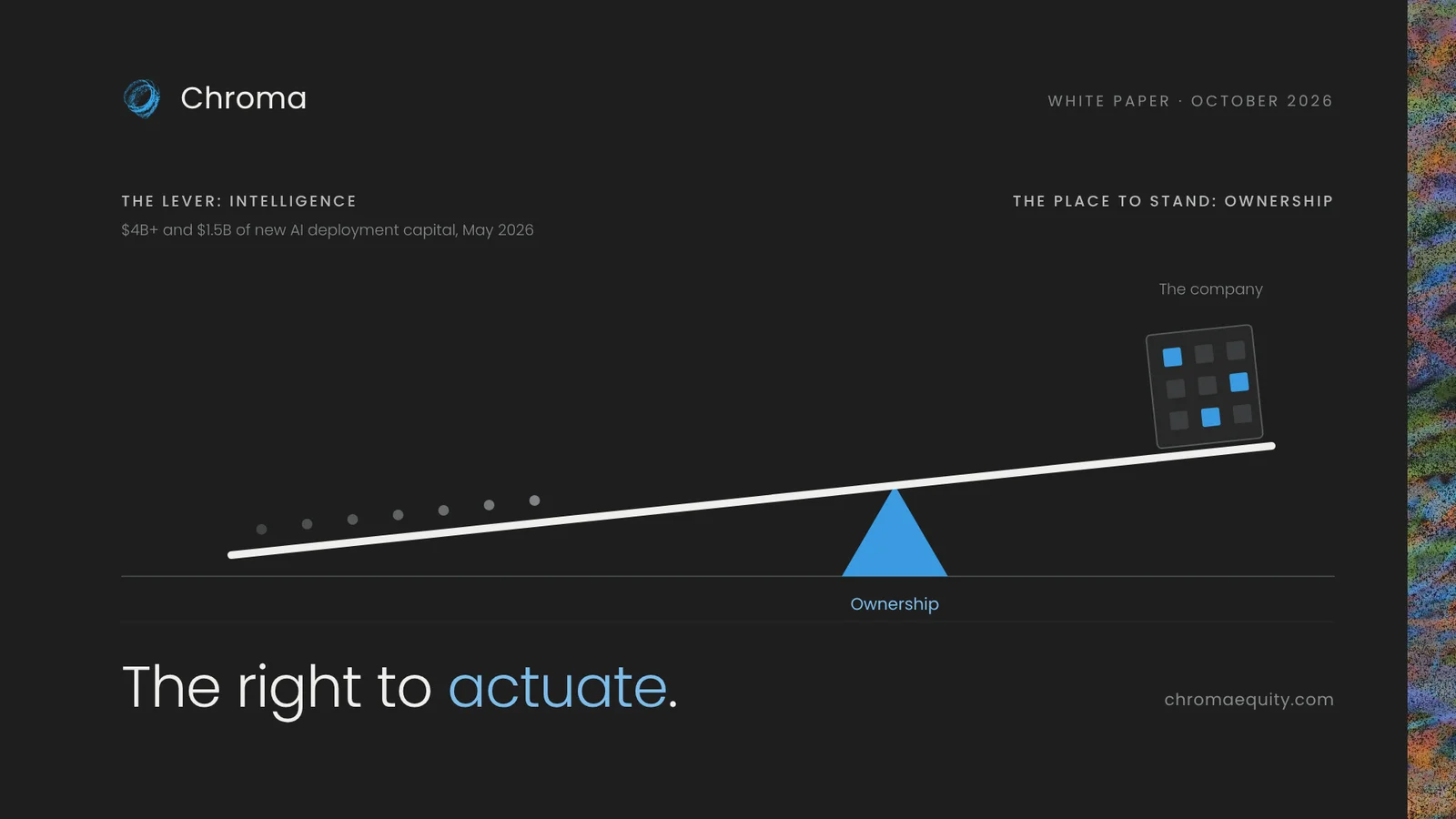
Our position. When intelligence becomes nearly free, the scarce input is no longer thinking. It is accountability: a named, licensed, insured person who will sign and be liable if they are wrong. Manidis and Roberts argue that the gains of the intelligence economy will pool in Commanding Heights, positions that durably capture a share of the activity they enable.1 We agree, and we think they have walked past one of the largest Heights still for sale. We call it the last signature. It sits inside a great many owner-run businesses in testing, inspection, field service and specialty manufacturing, most earning $1–10M of EBITDA. Every improvement in models makes the work around that signature cheaper, which means more of it gets done, and the holder of the signature is paid for every additional job. The essay calls for a new kind of private equity to buy these businesses and rebuild them around models. Chroma was built, before the essay was written, to do exactly that. A model cannot lose its licence. That is why the licence becomes more valuable every time the model gets better.
What the essay gets right
We read all 145 pages. A response should begin by stating the other side's case at its strongest, and on five points we think the authors are simply right.
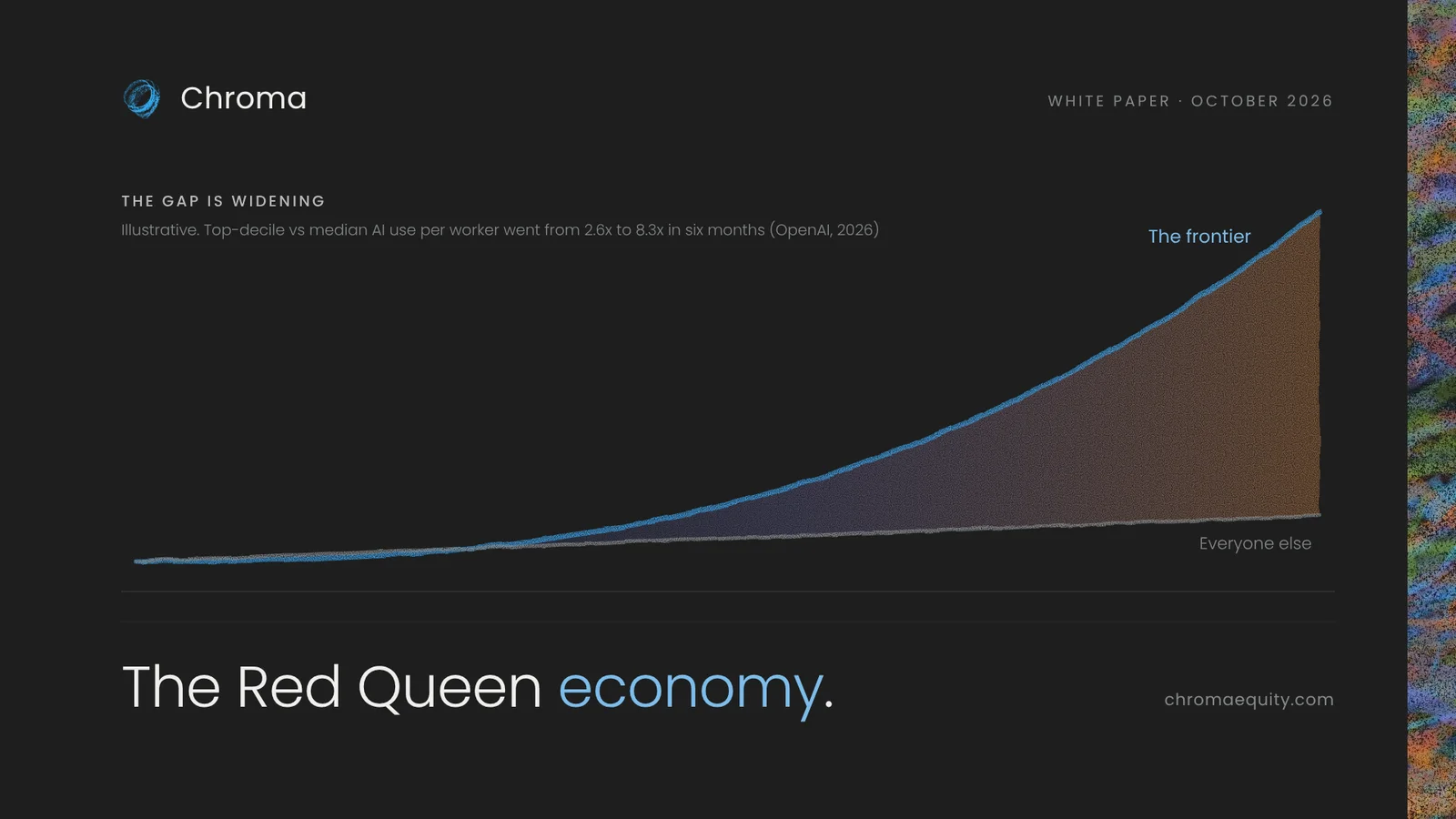
The inventors rarely keep the gains. From Gutenberg to the railroads to Standard Oil's pipelines, the people who build a technology are seldom the people who get rich from it. With about $800B of hyperscaler capex projected for 2026 and frontier models losing their edge within months, the authors expect the pattern to repeat.1
Scarcity is not enough. Durability is the test. Bottlenecks move: solve power and transmission becomes the constraint, solve that and it becomes chips. A true Height captures a share of the activity it enables, grows stronger as that activity multiplies, and survives the question of who else can claim its rent.1
Licensing will hold its value. When intelligence is abundant, a licence keeps its worth because it implies certainty: a surety, an audit signature, a liable human. Work that needs no stamp gets automated. Work that does keeps its people.1
The firm is being re-founded around operators. After the owner-operator, the professional manager and the shareholder-disciplined corporation, the fourth form of the firm fuses operators with capital while models do most of the work.1
The old private equity can't do this job. With the 10-year Treasury above 5% and a forty-year bond rally over, buyout funds that borrow against old cash flows and plan static five-year exits are the wrong tool. Someone must buy these companies, rebuild them around models, and keep them running while they do.1
We accept all five. Our disagreement is about where the authors looked.
What happens when the work gets cheap and the liability doesn't
The first-level view of AI and services is simple: machines will do the work, so the businesses that sell the work will shrink. Public markets have largely priced it that way. The essay itself describes much of the old economy trading at estate-sale prices.1
The second-level view asks what history says happens when the cost of a task collapses but the obligation behind it stays. The answer has been consistent for 160 years.
Coal, 1865. William Stanley Jevons noticed that more efficient steam engines did not reduce Britain's coal consumption. They increased it, because cheaper power made new uses worthwhile.3 Efficiency expands demand.
Bank tellers, 1990–2015. ATMs spread from about 100,000 in the US in 1990 to about 400,000. The number of bank tellers did not collapse. It held steady and rose slightly, because cheaper branches meant banks opened more of them, and tellers moved from counting cash to solving customers' problems.4
Radiologists, 2016–2025. In 2016 Geoffrey Hinton said people should stop training radiologists now. Nine years later, US programmes offered a record 1,208 radiology residency positions, up 4% in a year, and radiology was the second-best-paid medical specialty, at an average of about $520,000.5 Models read more scans than ever. A radiologist still signs the report, and is liable for it.
The pattern is the same each time. When intelligence makes the work cheaper, more work gets done. Where a human must still be accountable for the result, that human, and the business that employs them, captures a share of every additional unit. The market is pricing the businesses that hold the last signature as AI's victims. History says they are its beneficiaries.
Search is cheap. Selection isn't.
The investor who writes online as illiquid recently put the same idea in evolutionary terms. Models are commoditising mutation: the generation of candidate answers, targets and theories. They are not commoditising selection: the slow physical, institutional and biological work of finding out which answers are right. A model can propose a new drug target in seconds. Making, testing and measuring it still takes months at the very least. Search will expand far faster than our capacity to verify it, so the scarce resource becomes the real-world infrastructure of selection.19
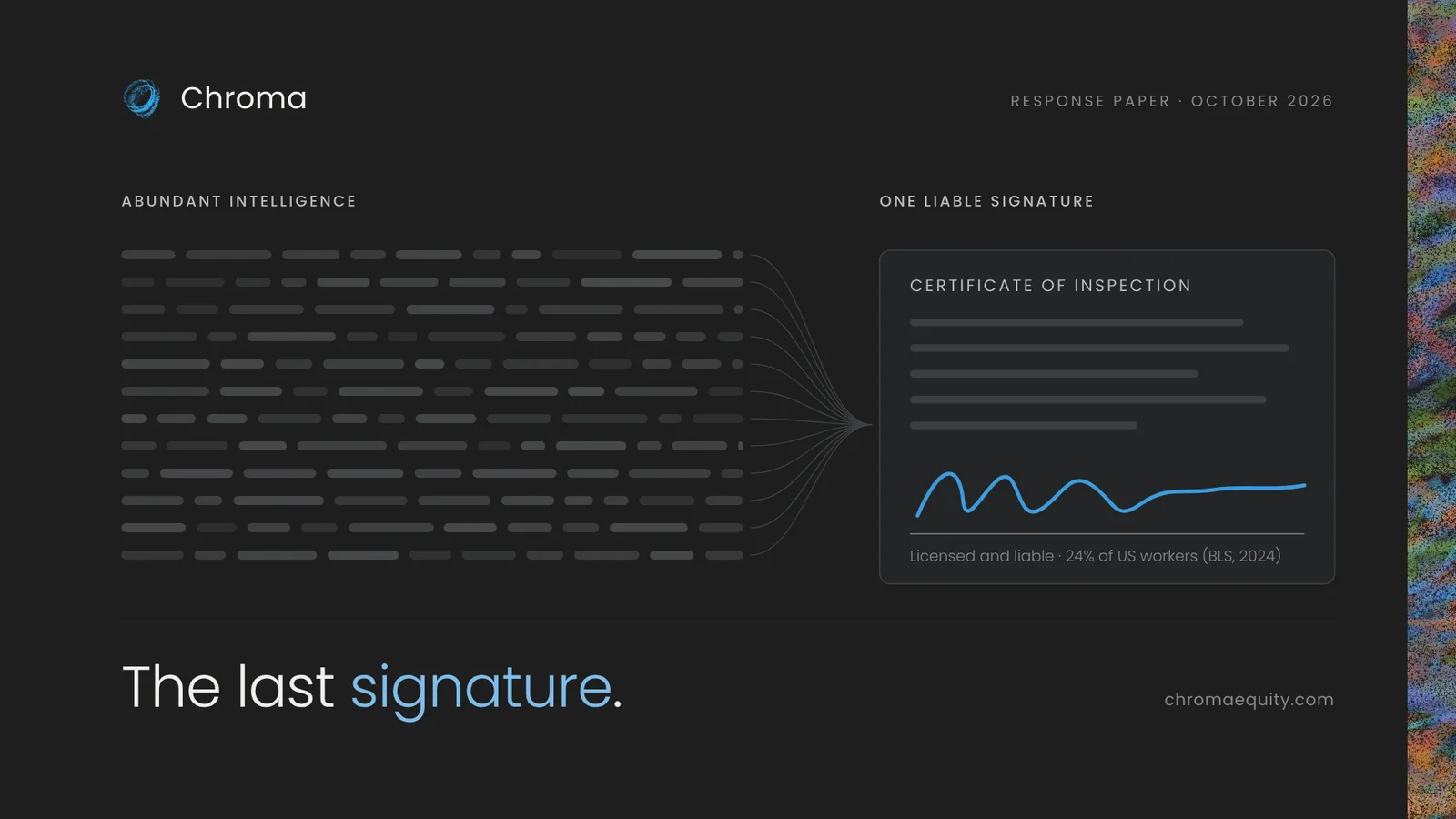
The last signature is selection infrastructure for the built world. A model can draft a thousand inspection reports before breakfast. Someone still has to decide which sprinkler systems pass, which switchgear is safe to energise and which elevator stays open, and be liable for that decision. As generation becomes free, the bottleneck moves to verification, and the people and firms licensed to verify capture what the bottleneck is worth.
It is the radiologist's lesson, stated as a rule: when search gets cheap, the value moves to whoever is allowed to select.
Where the signature lives
The last signature is not a niche. It runs through a quarter of the American workforce, and the businesses that hold it are about to face a squeeze on both supply and ownership.
A quarter of all workers carry it. In 2024, 24.0% of employed Americans, about 38.8 million people, held a professional certification or licence. About 34.9 million held a licence.6
A steady, mandated market. The US testing, inspection and certification market alone is estimated at about $50B, with the outsourced share growing fastest.7 The work is required by code on a schedule, whatever the economy does.
The signers are getting scarcer. Manufacturing, construction and the trades see about five retirements for every two replacements, and up to 2.1 million skilled-trades jobs could go unfilled by 2030.8 The essay adds the sharpest point of all: licensing protects incumbents and squeezes newcomers. By mid-2026, employment of 22- to 25-year-olds in AI-exposed occupations was 19% below trend, while experienced workers showed no gap.1 Fewer young people are entering, so every licensed person already in place is worth more.
The businesses haven't adopted the tools. About 20% of US businesses used AI in May 2026, against 37% of firms with 250 or more employees, and use was flat among the smallest.9
And the owners are leaving. About 6 million US small businesses will face an ownership exit by 2035. More than 1 million are viable for sale, worth about $5.1 trillion, yet in 2022 about 92% of small-business exits were closures.10
Read those five facts together. The work around the signature is about to become dramatically cheaper. The signature itself is becoming scarcer. And the businesses that hold it are changing hands, mostly to no one.
The Height test, applied
The essay sets a demanding test for a Commanding Height. We applied it as hard as we could.
| Their test | The last signature | Verdict |
|---|---|---|
| Scarcity | Licensed, insured, locally known technicians, with about five retirements for every two replacements 8 | Passes |
| Durability | The requirement is written into fire, building and electrical codes and into insurance terms. Capital can build a power plant. It cannot manufacture liability | Passes |
| Entrenchment | Cheaper inspection means more assets inspected more often, and the holder of the licence, the schedule and the record captures each extra job | Passes |
| Political claim | Code bodies set the rules and could change them. But the rent is small per job, spread across thousands of local customers, and visibly tied to safety | Passes, with care |
The grid is where you can see it today. The essay's own example of where margin pools is a finished data centre sitting dark, waiting for a grid connection.1 Data centres used about 4.4% of US electricity in 2023, and the Department of Energy projects 6.7–12% by 2028.11 New transformers can take up to three years to arrive.12 Nearly 2,300 GW of generation and storage was waiting in US interconnection queues at the end of 2024, and the median wait has doubled to more than four years.13 Every one of those connections ends the same way: a licensed crew tests the equipment and signs before anyone flips the switch. Most of those crews work for owner-run regional firms that no hyperscaler has ever heard of.
The essay's own best Height is a signature business. Hearst used newspaper cash flow to buy into Fitch Ratings in 2006, reached 80% in 2015 and paid $2.8B for the last 20% in 2018, implying roughly $14B for the whole firm (our arithmetic).14 The essay notes that Fitch is now Hearst's largest source of profit.1 A ratings agency sells one thing: a stamp that a regulated market is required to buy. That is the last signature at its grandest. We are buying the same idea at 6–7 times EBITDA.15
Slow is the moat
The essay's sharpest challenge to a firm like ours comes early. Forward-deployed engineering firms, it says, are limited by how many capable experts they can hire. AI services roll-ups struggle to buy and integrate each add-on. Both are too slow to spread intelligence at the speed it is becoming abundant.1
We agree with every word, and we draw the opposite conclusion.
It is a statement about the economy, not about returns. The authors concede that some of these firms may become durable businesses earning money for decades.1 Their complaint is that they can't diffuse AI across the whole economy fast enough. That is a policy problem. For an investor, the scarcity of people who can actually install intelligence inside a 30-year-old business is not a flaw in the strategy. It is the reason the strategy pays. If it were fast and easy, everyone would do it, and the return would be competed to zero.
The difficulty is where the margin of safety comes from. Installation inside small, old, regulated businesses is hard: old software, paper habits, customers who don't want to be transformed, and a licence that can't be put at risk. That difficulty is what keeps large capital out and what keeps the price at 6–7 times EBITDA rather than at a guild's premium.
We are not the roll-up they describe. Their caricature is a buyer bidding the highest price at auction for Midwestern accounting firms, betting that rival bidders can't yet deploy models.1 That is a bet on being briefly smarter than other bidders, in a business whose product AI is replacing. We buy one company at a time, directly from owners and rarely at auction, in physical and licensed services whose product AI can't replace. There is no add-on to integrate.
We designed around the hiring limit. Engineers who have rebuilt real businesses are scarce. So our playbook is built to get cheaper with every company, because the second pricing project reuses the first one's data. A bench of vertical AI partners handles the jobs every business shares: answering the phone, selling, billing and collecting. And our pace is set by quality, not by the need to deploy a fund.
The firm they describe, and the firm we built
The essay never names the new private equity it calls for. But read across its chapters and you can assemble its job description. Here it is beside how Chroma is built.
| What the essay says the new firm needs | How Chroma is built |
|---|---|
| No borrowing against old cash flows, no static five-year exit 1 | Little or no debt and no fixed exit date, at a time when a typical leveraged buyout needs 10–12% annual EBITDA growth just to earn 2.5x 16 |
| Refurbish the company while the wheels keep turning 1 | Systems before sales. Nothing customers rely on is switched off. Every change agreed in writing before signing and introduced in stages over 12–18 months |
| Rebuild around models 1 | Our own engineers inside every company, connecting the business to one data layer, plus a bench of vertical AI partners |
| Own a durable toll, not a fleeting bottleneck 1 | We buy the last signature: mandated, recurring, local work that a liable human must sign |
| Pay and govern operators like capital 1 | Owners can roll over equity. General managers get partnership-style economics tied to value created, not salary and bonus |
| Go where large capital can't | $1–10M of EBITDA. Funds of $500M or more took about 81% of LP dollars in 2025 and can't write $15M checks at scale 17 |
| Buy before the Heights are priced 1 | Direct from founders facing succession, and from the fund-owned companies the essay's estate-sale market can't clear |
The data layer is their good-regulator idea, made practical. The essay cites the cybernetic principle that the best regulator of a system must be a model of that system.1 In a 40-person inspection company, that begins with something unglamorous: every asset, job, quote, reading and certificate in one place. It is the first thing our engineers build, and everything else, from pricing to recurring contracts, is built on it.
The arithmetic of a signature
Principles are cheap. Here is what the last signature is worth in a single company. The figures are our illustration, not a forecast and not a Chroma result.
Take a regional testing and inspection company with $15M of revenue and a 15% EBITDA margin: $2.25M of EBITDA, bought at 6x for $13.5M, with no debt.
| Lever | Assumption | Added EBITDA |
|---|---|---|
| Capacity | Routing, scheduling and machine-drafted reports give back 10% of each technician's week, filled from the existing backlog at a 50% incremental margin | +$0.75M |
| Price | A 3% increase on work that hasn't been repriced in years, with no customers lost | +$0.45M |
| Total | No new technicians, no cuts | $2.25M to $3.45M, up 53% |
At the same 6x, the company is worth about $20.7M, before counting the cash it paid out along the way. We have not assumed a higher exit multiple, though buyers usually pay one for bigger, more predictable companies.15 Price is the most powerful single lever: McKinsey found that for a typical large company, a 1% price rise lifts operating profit by about 8%.18
The bigger prize is a change of model. Where a code allows remote or automated readings for some tasks, the business can move from billing per visit to billing per asset under contract. The technician stops driving to every site and starts supervising a fleet of sensors, signing where a signature is required. Revenue becomes recurring and margins widen.
Here is the subtle part, and the reason the licence matters. Without it, those savings would be competed away: any customer could buy a cheaper machine reading from anyone. With it, the customer still needs the stamp, and the business that holds the stamp keeps the margin. Intelligence lowers the cost. The signature decides who keeps the savings.
Where we part ways
On people. The essay expects the new private equity to adjust the workforce, which in context means fewer jobs.1 Our target is the opposite: every company we own should employ more people when we sell it than when we bought it. That is not sentiment. It follows from the essay's own logic and from history. Where the liable human stays, cheaper work means more work, as it did for bank tellers and radiologists.45 A technician freed from paperwork and driving can serve demand the business used to turn away, and the business needs more licensed people, not fewer.
On data. The essay suggests that firms whose value is mainly their data should sell it, and that being a training environment for AI labs will pay. Its example is Google and Mercor bidding for Spirit Airlines' operational records in bankruptcy.1 The records of a well-run inspection company are valuable, and we will organise them well. But customers trust these businesses with the safety records of hospitals, schools and factories. We will not treat that trust as inventory. Any use of data beyond serving the customer will be agreed with the customer first.
On where to look. The essay is written from the top of the economy: sovereigns, hyperscalers, trillion-dollar flows. Its authors are right that most of the old economy will be absorbed or crushed by what is coming.1 We think the exceptions are where the best returns of the decade will be found, and that they are too small for anyone the essay is addressing to buy.
What would prove us wrong
A thesis worth holding should say how it fails. Ours fails if any of these happens.
Codes and insurers stop requiring a human. If regulators broadly accept machine sign-off, the last signature becomes a commodity. We think this will move slowly and unevenly, jurisdiction by jurisdiction, because liability has to land on someone. We will track it market by market and stop buying where it moves.
The political claim arrives. If a regulator decides inspection margins are too high, it can cap them. Our protection is that the rent is small per job and its value to customers is visible. It is not zero risk.
Large capital comes down-market. If AI holding companies or large sponsors start paying 8–10x for small licensed businesses, our price advantage narrows and we will buy less.
We can't hire the builders. If engineers who have rebuilt real businesses won't join a small firm, the model doesn't run.
We have designed Chroma so that each of these shows up early, company by company, rather than at the end of a fund.
Our recommendation
The essay closes by warning allocators that holding the last era's winners and funding this era's inventions will both miss what comes next. Only re-mandated managers, it argues, can claim the new Heights while they are still for sale.1 We agree, and we would make the instruction specific.
For allocators: keep paying beta prices for beta. Then put part of the alpha budget behind a manager built for the fourth settlement: unlevered, control-oriented, engineering-led and small on purpose, buying the last signature before anyone prices it as a Height.
For owners: if your business holds a signature the world will still need, it is worth more to an owner who can surround it with intelligence than to one who only plans to cut. Talk to us before you talk to an auction.
For ourselves: a small number of companies, each with a written plan, with results reported lever by lever. If the last signature is the Height we think it is, the evidence will arrive one company at a time.
The essay says the Heights are never common and never offered. It is right. This one isn't listed on any exchange. It isn't in a seed portfolio or a hyperscaler's capex plan. It is in a van outside a hospital at six in the morning, in a binder of inspection tags, in a licence number painted on a truck door.
Intelligence is about to become nearly free. Responsibility never will.
Someone has to sign. We intend to own the companies that do.
— Chroma Partners