"The time of maximum pessimism is the best time to buy."
— Sir John Templeton
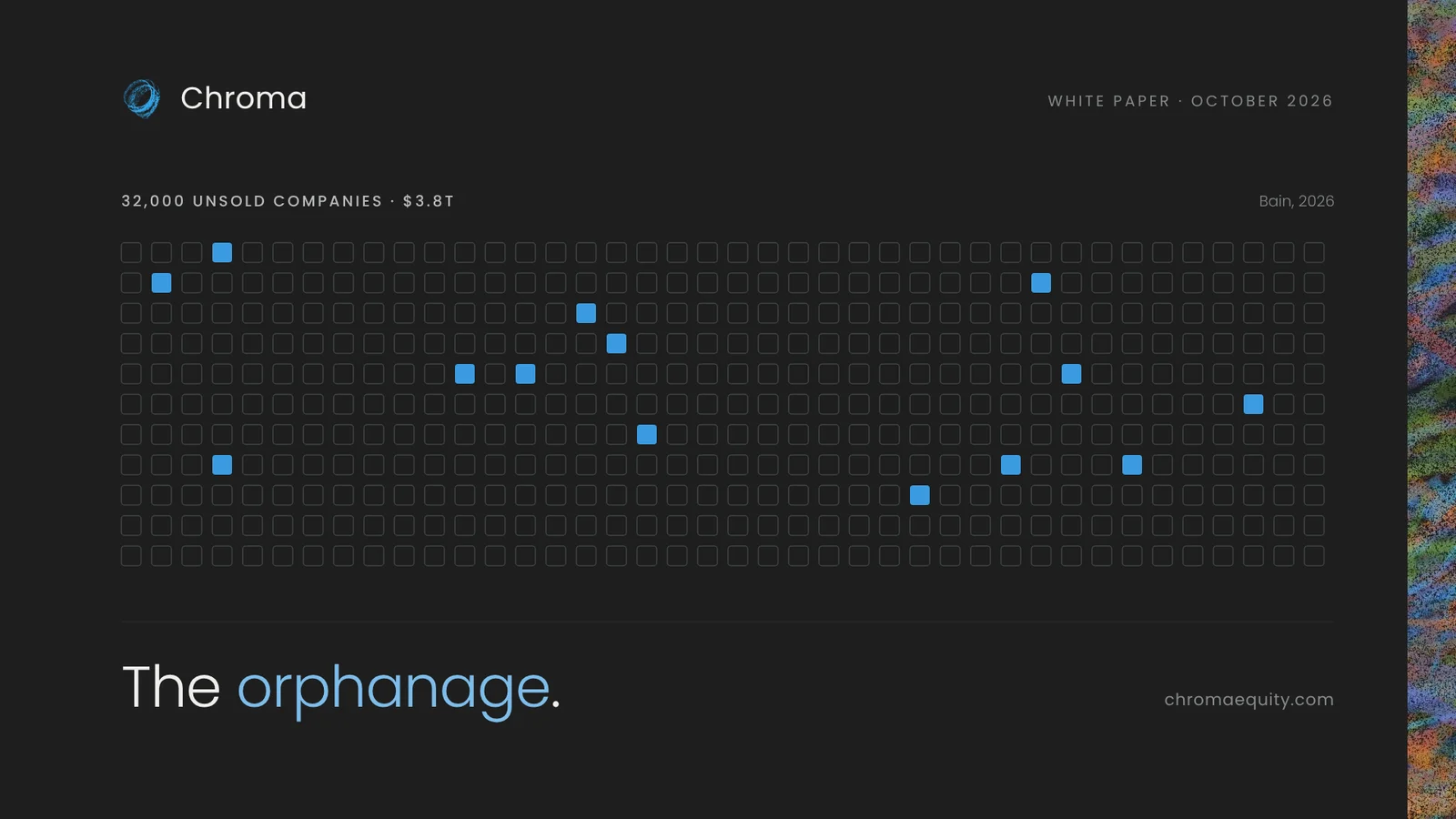
Our position. The best small companies for sale in America over the next five years may not belong to retiring founders. They may belong to funds that can't sell them. Private equity is sitting on about 32,000 unsold companies worth $3.8 trillion. Venture is in worse shape. The industry's answer has been financial: continuation vehicles, amend-and-extend, and marks that drift above what any buyer will pay. Those buy time. They don't produce a buyer. Hidden inside this backlog is a large, ignored pool of small, profitable, perfectly good businesses: too small for the sponsor that owns them to care about, too slow for the venture fund that owns them, and too complicated for an individual buyer to untangle. They are orphans. We think they deserve an owner who will price them on cash flow rather than their last mark, structure around the capital stack, and then do the work.
The private equity backlog
Private equity bought faster than it could sell, and the bill is now due.
| Signal | Figure | Ref. |
|---|---|---|
| Unsold PE-backed companies worldwide | About 32,000, worth $3.8T | 1 |
| Typical buyout hold at exit | About 7 years, up from 5–6 in 2010–2021 | 1 |
| Distributions as a share of NAV | About 14%, the lowest since 2008–09 | 1 |
| US buyout NAV in funds more than 7 years old | More than $860B | 3 |
| US 2021 platform buyouts still held | 1,869 of about 2,500 (75%) | 3 |
| 2021 buyout vintage DPI at year four | 0.14x | 3 |
| Companies held 5+ years with no deal of any kind since 2021 | 3,332 of 6,437 (about 52%) | 3 |
| US middle-market companies unsold | More than 6,400, about a third held 5+ years | 3 |
| Median NAV of buyout funds at or past liquidation age | Close to 25% of commitments, up from the mid-teens in 2016–21 | 4 |
The workarounds are piling up. GP-led continuation vehicles grew 62% in 2025, about 37% a year since 2022, yet still account for less than 10% of PE exit value.1 Amend-and-extend deals on portfolio debt have more than doubled since 2021.3 And when continuation vehicles do price, they price below prior carrying value.3 The marks are optimistic, and everyone in the room knows it.
PitchBook's own term for the worst of these is "zombie": a company that is solvent and operating but has no credible path to its target return or a timely exit.3
The venture hangover
Venture's 2020–22 cohort raised money for a world that no longer exists, and AI has just repriced what's left.
| Signal | Figure | Ref. |
|---|---|---|
| Median DPI, 2019 and 2020 venture funds | "Barely over zero". Less than half have returned any capital | 5 |
| US startup shutdowns on Carta, 2024 | 966, up 25.6% from 2023 | 6 |
| Share of those shutdowns in enterprise SaaS | 32% | 6 |
| Unicorns with no new funding in 3 years | Up to 383 of 1,900 tracked | 7 |
| Expected net valuation cuts across unicorns | $500B to $1T | 7 |
| US VC fundraising | $223B in 2022, $66B in 2025 | 7 |
| Value of startups last funded in 2021 | Down about 68% on average | 8 |
| Software marks in PE portfolios, Q1 2026 | Down about 8% | 2 |
The venture model only works if a few companies become enormous. Everything else is supposed to fail fast or sell quietly. The quiet middle has become a problem: thousands of real businesses, with customers and revenue and sometimes profits, that will never return the fund. Their investors need liquidity, not another board meeting.
Where the bodies are buried
The orphans aren't the famous zombies. They are the small, boring, profitable companies nobody upstream is paying attention to. We see four types.
The sub-scale platform. A sponsor bought a $3M-EBITDA business in 2019 to build a platform. The add-ons never came, or never worked. It is a perfectly good company, now a rounding error in a $3B fund, and the deal partner who championed it has moved on.
The stranded add-on. A bolt-on that never integrated, sitting inside a larger platform the sponsor wants to sell clean. It is worth more to a focused owner than to anyone else.
The profitable venture misfit. A vertical-software or tech-enabled services company that raised at 2021 prices, grew into a solid $10–30M revenue business and turned profitable. It will never be a unicorn. Its preference stack is bigger than what any buyer will pay, so the founders and employees hold common shares that are underwater.
The orphaned division. A product line or regional business inside a PE-owned company that no longer fits the story the sponsor is telling its next buyer.
What they share is a misaligned seller. The owner isn't a founder deciding whether to retire. It is an institution with a fund clock, an LP asking for distributions and a carrying value it doesn't want to write down. That is a motivated seller with no natural buyer.
Why nobody is buying them
Every obvious buyer has a reason to pass.
| Buyer | Why they pass |
|---|---|
| Large and mid-market sponsors | Too small to be a platform. Sponsor-to-sponsor deals already make up 53.5% of exits, and buyers want scale, not leftovers 3 |
| Strategic acquirers | Want growth or synergies. A slow, profitable niche business rarely moves their numbers |
| Growth and venture investors | Want companies that triple each year. These grow 10–20% |
| Search funds and individual buyers | Lack the capacity to negotiate a preference stack, a continuation-vehicle process or an institutional seller's legal machinery |
| Continuation vehicles | Built for the sponsor's best assets, not its orphans |
The second-level view
The first-level view says these are leftovers: if they were any good, someone would have bought them. The second-level view asks why nobody has. The answer is rarely the business. It is the seller's clock, the size of the check and the complexity of the capital stack. Those are reasons for a low price, not for a bad company.
As Howard Marks has long argued, few assets are so good that they can't become a bad investment at too high a price, and few are so bad that they can't be a good one when bought cheaply enough. When the natural buyers pass and the seller has a clock running, price is set by cash flow, not by the last round or the last mark. And these businesses often come with what a founder-owned company lacks: audited financials, a management team, a CRM and a board. Half the professionalising work is already done.
Our view: the next five years will produce more good, cheap, small companies from fund portfolios than at any time since the financial crisis. The firms that win them will be the ones that can talk to a GP's investment committee, untangle a capital stack and run a business the morning after closing.
How to buy an orphan well
Orphans are cheap for reasons. Buying one well means respecting those reasons.
What we look for. A business that is profitable today, or one step from it, because cash flow is the anchor and we never underwrite to the plan that got it funded. Customers who stay, because high retention says the business is real whatever happened to its growth story. Overhead built for a different plan, because venture-era cost structures and sponsor-era layers are often the easiest improvement available. And a management team worth keeping, with a reason to stay.
How we structure it.
| Problem | Structure |
|---|---|
| The seller's mark is above what we'll pay | Price on cash flow. Give the seller a rollover stake so they share in the recovery instead of crystallising a loss today |
| The preference stack exceeds the price | Negotiate with preferred holders first. They usually prefer a clean, certain return of capital to an uncertain one |
| Management equity is underwater | Reset it, with a new incentive pool tied to the value we create together |
| The seller wants current income | A small current-pay preferred slice, so cash flows to the seller from day one |
| Fear of buying a lemon | Our engineers and operators spend weeks inside before the price is final |
| The temptation to lever it | Don't. Little or no debt, so the recovery isn't spent servicing a loan |
What we avoid. Businesses with no path to profit, companies whose value is a single contract or a single person, and anything whose main appeal is the size of the discount to its mark. A big discount to a bad number is still a bad number.
What we don't know
We don't know how long sponsors will hold out on their marks, or whether a recovery in exits will clear the backlog faster than we expect. If it does, the opportunity shrinks and we will say so. We also know that some orphans are orphans for good reason. Our protection is the work we do before the price is final, and our willingness to walk away.
Why Chroma
Chroma has two doors: founder successions, and structured control from sponsors, venture funds and corporates. This paper is about the second, and it is where our design matters most.
We speak the seller's language. We price on cash flow but understand what a GP needs: a clean exit, a defensible mark, an LP story and certainty of close.
We can untangle the stack. Rollovers, preferred slices, management resets and seller paper are standard tools for us, not obstacles.
Our engineers like messy software. Venture-era products and tech-enabled services companies are where engineers who have re-platformed real businesses add value fastest.
We bring a bench, not just capital. Vertical AI partners plug into each company to help it sell more, collect faster and run leaner.
We don't need debt to make it work. An orphan bought unlevered at a sensible price can pay cash back while we rebuild it, and the old owner's rollover means they want it to succeed too.
We're the right size. A $10–30M equity check is a rounding error to the funds that own these companies. To us, it is the whole point.
The founder succession wave is the opportunity of the decade. The fund backlog is the opportunity of the next five years. Pessimism about this corner of the market is close to its peak. We would like to be the buyer they call.
— Chroma Partners