"The future is already here. It's just not very evenly distributed."
— William Gibson
Our position. America's small businesses employ nearly half its private workforce and produce over 40% of its GDP. A generation of their owners is now retiring, and most of those businesses will close rather than sell, including many that are perfectly viable. The ones that survive are falling further behind the productivity frontier, because the tools that lifted large companies never reached them. And the skilled technicians they run on are retiring faster than they can be replaced. The next decade is therefore a choice: let a large part of the productive economy quietly shrink, or rebuild it. Rebuilding it needs a kind of capital that barely exists today: patient, low-debt, small enough to care about a $3M business, and able to do the operating work itself.
How much of the economy they carry
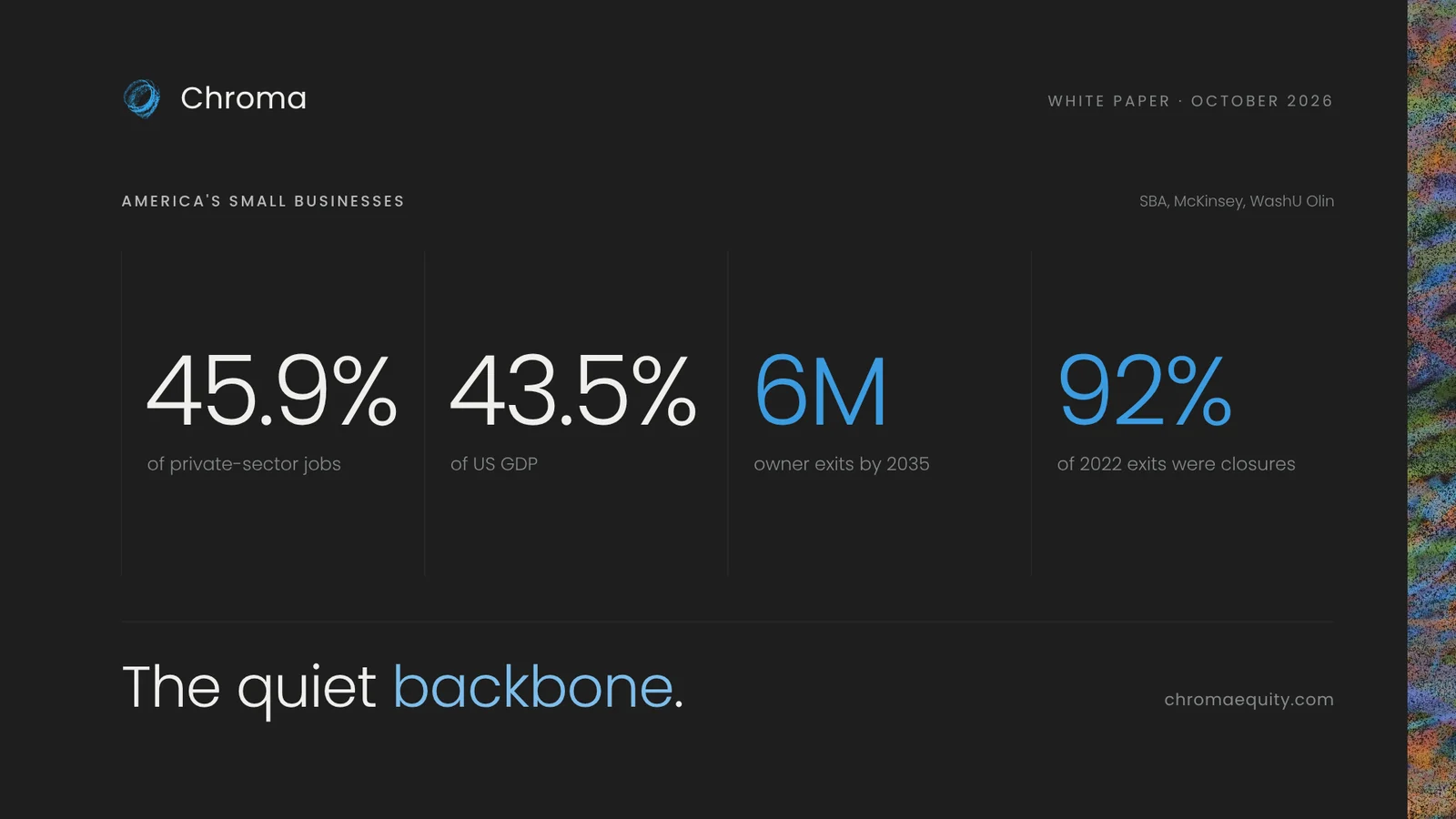
Small businesses are not a niche. By the government's own count, they are close to half of the private economy.
| Measure | Small businesses | Ref. |
|---|---|---|
| Number of businesses | 34.8 million (6.3 million with employees) | 1 |
| Share of private-sector jobs | 45.9%, about 59 million workers | 1 |
| Share of net new jobs, Jan 1995 to Jun 2023 | 61.1% | 1 |
| Share of GDP | 43.5% | 1 |
| Share of known export value | 34.9% ($541.6B) | 1 |
The businesses we care about most are a specific slice: established B2B companies, often with 20–200 employees, that keep physical systems working. They inspect sprinklers and elevators, test materials, service industrial equipment, and make precise parts nobody else wants to make. Their work is mandated, recurring and local. When one disappears, a hospital, a school district or a factory loses a supplier that took decades to build.
The succession cliff
The largest transfer of business ownership in American history is under way, and most of it is ending in closure.
The owners are aging out. About half of US employer businesses are owned by someone 55 or older.2 Baby-boomer owners hold about 2.3 million businesses employing 24.7 million people.3
Exits are accelerating. McKinsey projects that about 6 million US small businesses will face an ownership exit by 2035, up from 4.5 million in the prior decade. More than 1 million of them are viable for sale or transfer, representing about $5.1 trillion of enterprise value.4
Most exits are closures. In 2022, about 92% of US small-business exits were closures. Only 5% were sales and 3% were transfers.4
Many owners have no plan. In a 2024 Gallup survey, 27% of owners with employees either planned to close or didn't know what would happen to their business.5
A viable business that closes for want of a buyer is a pure economic loss. Its customers, its jobs and the know-how its people built all disappear, for no better reason than that nobody showed up with the right capital and the patience to take it on.
The productivity gap
The businesses that do survive are falling behind, and the cause is diffusion, not ability.
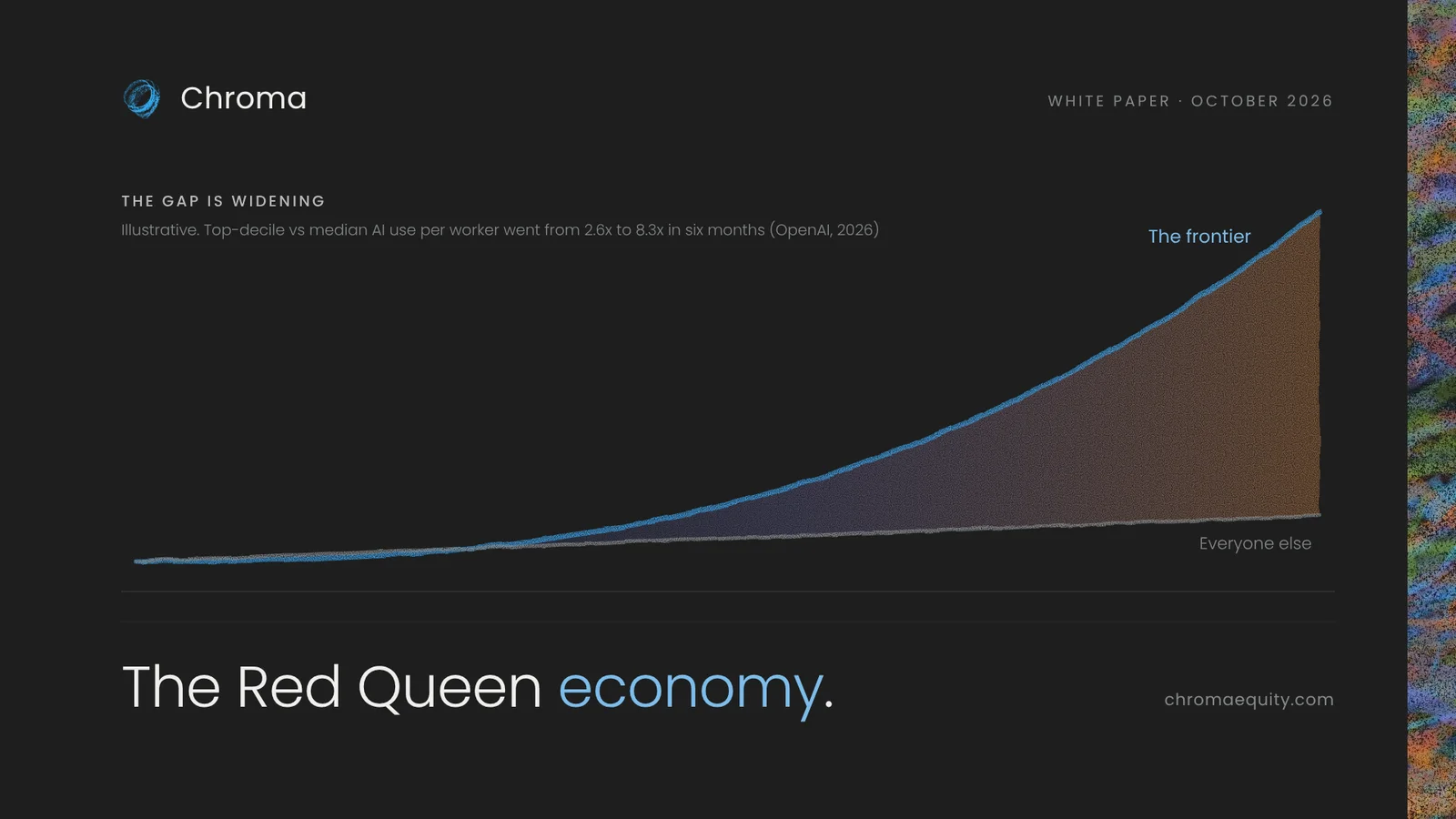
The frontier is pulling away. The OECD's study of firms in 24 countries found that between 2001 and 2013, labour productivity at the global frontier in manufacturing grew about 2.8% a year, against about 0.6% for everyone else. The gap in business services was wider still. The authors traced it to a breakdown in how technology spreads: laggards often lack the managerial and organisational capability to adopt what the leaders use.6
Management is the missing input. The World Management Survey found that a one-point improvement in management practices is associated with the same output gain as a 25% larger workforce or 65% more capital. Family firms run by the founder's eldest son or grandson were among the worst managed of any ownership type.7
AI is repeating the pattern. In the Census Bureau's survey, about 20% of US businesses used AI in May 2026, against 37% of firms with 250 or more employees and 32% of those with 100–249. Use rose among firms with 20 or more employees but was flat among smaller ones.8
The implication is uncomfortable. Each wave of technology widens the gap unless someone carries it into the businesses that can't adopt it alone. The binding constraint isn't the software. It is the people, and the ownership, to put it to work.
The labor wall
The skilled people these businesses depend on are retiring faster than anyone can replace them.
| Signal | Figure | Ref. |
|---|---|---|
| Skilled-trades jobs that could go unfilled by 2030 | About 2.1 million | 9 |
| Possible annual economic cost | About $1 trillion (US Department of Education estimate) | 9 |
| Retirements per replacement in manufacturing, construction and trades | About 5 for every 2 | 9 |
| Trades job postings against apprenticeship entrants, last year | About 600,000 against about 150,000 | 9 |
| Projected job growth to 2034 | Electricians 9.5%, HVAC technicians 8.1%, all jobs 3.1% | 9 |
This changes what technology is for in these businesses. The goal isn't to replace the technician. It is to multiply each one: route them better, take paperwork and travel out of their day, let machines handle the routine readings, and point the expert at the work only an expert can do. A business that gets more out of each licensed person can grow into demand that would otherwise go unserved.
What most people see, and what they miss
The "silver tsunami" is not news. Most of the market sees it as deal flow: a large supply of small companies to be bought, bundled and sold on.
We think that misses the point twice. First, the larger loss is not in the businesses that sell but in the ones that close, which make up about nine in ten exits, and many of which were viable. A buyer that only shows up at an auction never meets them. Second, buying these businesses is the easy part. The value lies in what happens after: closing the management and technology gap that kept them small. A roll-up that simply aggregates them changes the ownership and leaves the gap in place.
What fixing it is worth
Even a modest change at this scale moves the national numbers. This is illustrative arithmetic, not a forecast. If small businesses produce about 43.5% of GDP and their productivity growth rose by just 0.5 points a year, the economy would grow about 0.2 points faster every year from that alone, before counting the jobs kept by businesses that would otherwise have closed.
The capital to do this mostly doesn't exist yet.
Large funds can't come down. In 2025, funds of $500M or more took about 81% of LP dollars raised.10 A fund that size cannot spend its time on $15M checks.
Individual buyers can't build. Search funds and individual acquirers bring one operator and usually heavy debt. They rarely bring an engineering team.
Leverage is the wrong tool. A business carrying heavy debt can't afford its first salesperson or a two-year systems build. The cash goes to the lender first.
What we don't know
We don't know how many owners will choose to sell rather than close, how quickly AI tools will become simple enough for small firms to adopt without help, or whether the trades shortage will ease. We are confident about the direction of all three, and humble about the timing. That is one reason we use little or no debt: it lets us be right slowly.
Where Chroma fits
Chroma was built for this gap. We buy established businesses with $1–10M of EBITDA, usually from owners who need a successor, and take majority ownership with little or no debt. Our own engineers then move each business from people to systems, alongside a bench of vertical AI partners. On that foundation we build what it never had: real pricing, a sales engine and recurring service contracts.
The businesses get bigger, more productive and easier to own. The know-how stays in the community instead of closing with the founder. And the work compounds, because every company we rebuild teaches us how to rebuild the next one.
We think this is some of the most important work in American business right now. It is unglamorous, it is slow, and it is badly needed. The future is already here. Our job is to distribute it.
— Chroma Partners