"Past performance is not indicative of future results."
— The disclaimer at the bottom of every fund's marketing deck
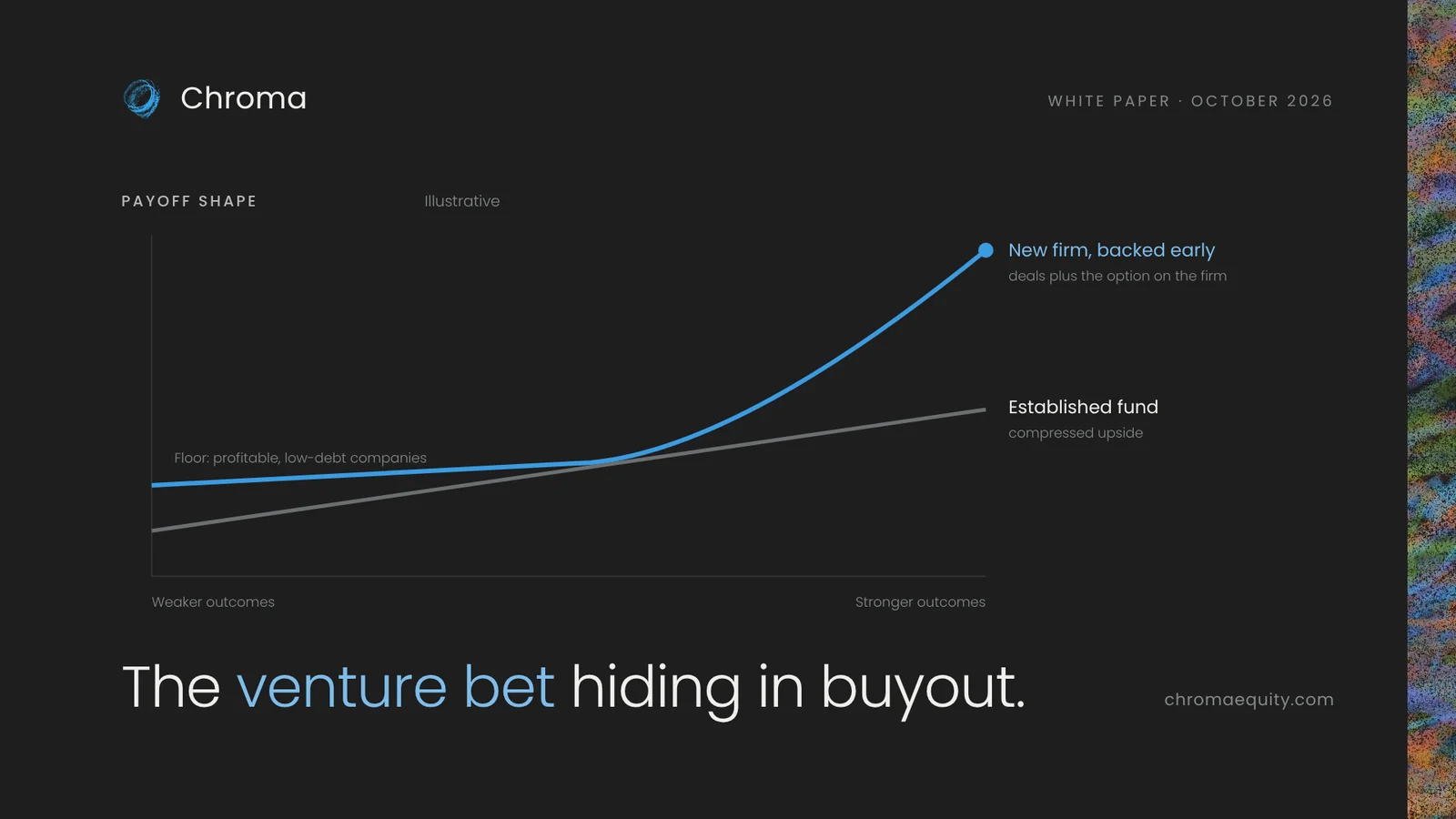
Our position. Institutional investors say they want asymmetric returns. Then they spend their buyout budget on the least asymmetric thing in private markets: the tenth fund of a firm that is already huge. We think there is a better trade hiding in plain sight. Backing a new buyout firm early is a venture bet with a buyout's downside. The downside is bounded, because the money goes into real, profitable companies bought cheaply with little or no debt. The upside is venture-like, because many of today's greatest firms began as tiny first funds, and their earliest backers got access and influence that later investors could not buy at any price. And the track record LPs would otherwise pay for is worth less than they think. Chroma has no track record. We think that is precisely the point: the moment to back a firm is before it has one.
Track records are worth less than LPs pay for them
The industry's central assumption is that past performance predicts future performance. For buyouts, the evidence says it largely stopped doing so around 2000.
Persistence collapsed. After 2000, buyout firms whose last fund was top quartile produced another top-quartile fund 22% of the time, nearly the same as firms coming off a bottom-quartile fund. The fund before last predicted "nothing at all".1
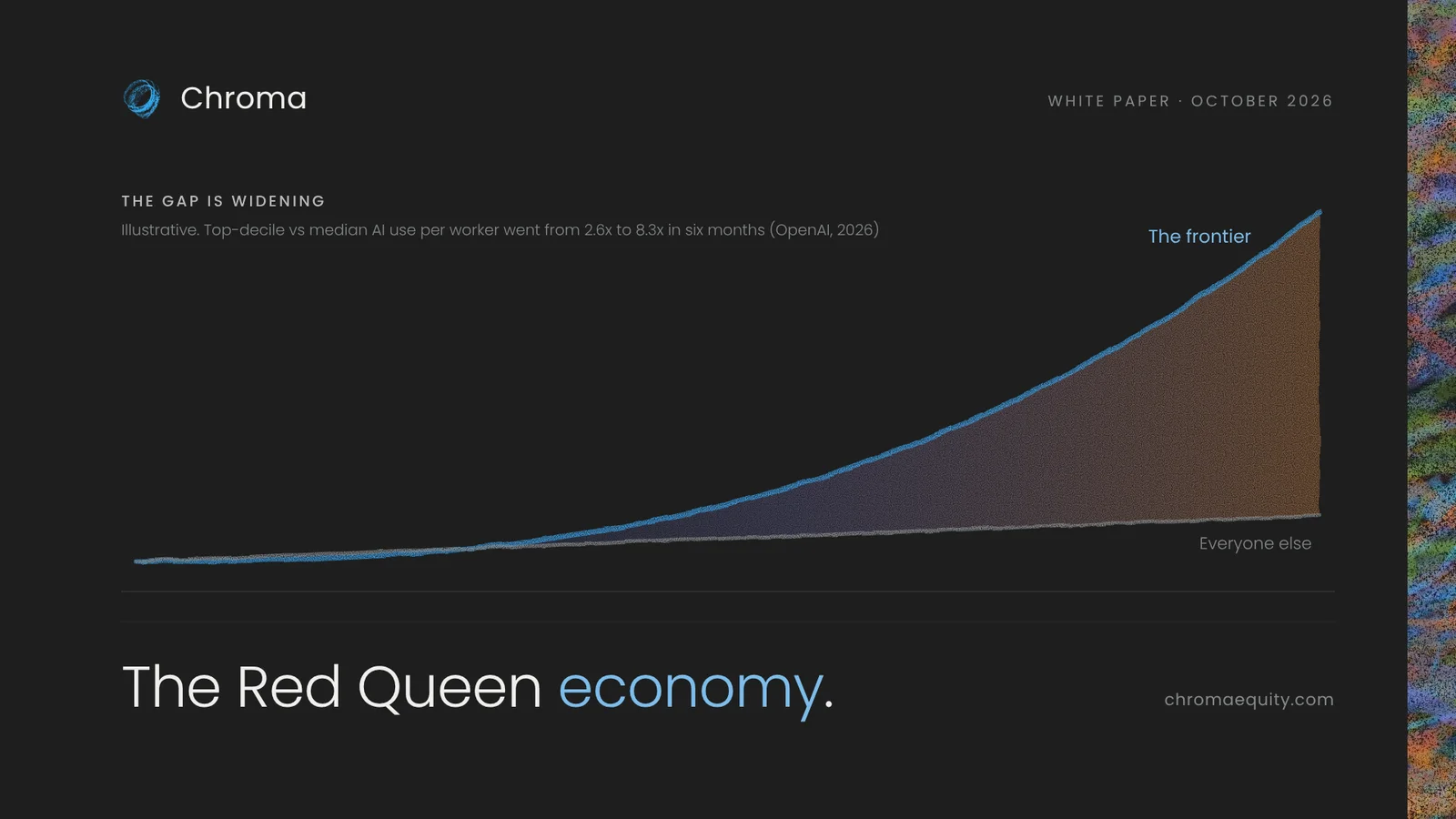
Old track records were earned in a different market. The returns behind today's flagship funds came from falling rates, cheap debt and rising multiples. Bain's 2026 report says those levers are gone: a typical deal now needs 10–12% EBITDA growth a year to earn what 5% used to.2
And LPs pay heavily for them. Funds of $500M or more took about 81% of LP dollars in 2025, even as smaller funds posted higher median returns.3
A track record built on leverage and multiple expansion is a record of a market, not of a skill that will repeat. The skill this decade needs, building value inside companies, is one most large firms have never had to prove. LPs are paying a premium for exactly what their managers' own disclaimers warn against.
Every giant was once a first fund
The firms LPs line up for today all began as scrappy, unproven teams that most investors turned down.
| Firm | How it started | Today | Ref. |
|---|---|---|---|
| KKR | Three bankers left Bear Stearns in 1976 after it refused to back a buyout fund. Their first institutional fund, in 1978, had just over $30M | $553B under management (2023) | 4 |
| Bain Capital | Founded 1984. The partners spent about a year raising a $37M first fund amid investor skepticism, putting in $12M of their own. By 1985 the founder considered shutting it down | About $185B. The first fund was generating annualised returns above 50% by 1989 | 5 |
| Blackstone | Founded 1985 with $400,000 of seed capital. Closed its first PE fund just after the 1987 crash | About $1.2T | 6 |
The lesson isn't that every new firm becomes Blackstone. Most won't. It is that the investors who backed these firms first got something that could never be bought later: access to the next funds, influence over how the firm was built and, often, a share of the firm's own economics. Those are option-like payoffs, and they are available only once, at the start.
The data on first funds supports the bet. In PitchBook's study, first-time funds had a median IRR of 10.9% against 11.1% for later funds, with similar downside, but they were more likely to post IRRs above 25% (18.3% of the time).7 And after the rules of the market changed, they did better: median net IRRs of 22.0% against 14.7% for 2011 vintages, and 21.1% against 13.2% for 2020, in a study of 731 first-time buyout funds.8
The venture logic: asymmetric upside, buyout downside
Venture investors accept that most bets fail in exchange for a few that return everything. A new buyout firm offers a similar shape of upside without venture's failure rate, because what you own on day one is a profitable business, not a pitch deck.
| Venture fund | Established buyout fund | Backing a new buyout firm early | |
|---|---|---|---|
| What you own | Minority stakes in unprofitable startups | Levered stakes in mature companies | Control stakes in profitable, low-debt companies |
| Downside | Many companies go to zero | Leverage can wipe out equity | Bounded by cash flow and little debt |
| Upside | Power law: a few huge winners | Compressed: 2–2.5x targets | Deal returns, plus the option on the firm itself |
| Access later | Hard to get into top funds | Easy, at scale | Capacity in later funds that may close to new investors |
| Influence | Little | Little | Real: on governance and how the firm is built |
The option on the firm is the part LPs overlook. In the GP-seeding market, an anchor investor in a first fund can receive an economic stake in the manager itself, along with rights to capacity in later funds and co-investment.9 If the firm becomes one of the next generation's leaders, that is the venture payoff. If it doesn't, the investor still owns the underlying companies.
In a market where capital availability "has disproportionately hurt new firms", as TPG's emerging-manager platform put it,10 early investors have unusual leverage. This is a moment when the buyer of the option sets the terms.
Hunger as an asset
LPs treat a new firm's hunger as a risk to be managed. We think it is the asset.
| A new, hungry firm | A large, established firm |
|---|---|
| Every deal is make-or-break, so the partners are in the room for all of it | Senior partners spread across dozens of companies and the next fundraise |
| Paid mainly if companies succeed | Fees on tens of billions can matter more than carry |
| Built for today's market from scratch | Built for cheap debt and rising multiples, and slow to change |
| Takes the $15M deal seriously | Can't move the needle with it |
| Will hire engineers and build new capabilities | Would have to retrofit them into a 500-person firm |
| Wants the LP relationship and will earn it | Has a waiting list |
There is also a selection effect. Founders who leave secure careers to start a firm in the hardest fundraising market in a decade are self-selected for conviction. Bain Capital's founders put $12M of their own money into a $37M fund and still nearly shut it down in year one.5 Grit is what got them to year five.
CalPERS' own staff has noted that the gap between top-quartile and median managers is double any fee savings.10 Picking the right manager matters more than anything else. The real question is whether you would rather pick them before everyone else does, or after.
How to make the bet safely
A venture-style bet on a firm makes sense only if the downside is genuinely bounded. That is a question of structure. These are the protections we think any investor in a new firm should insist on:
No blind pool. Without a track record, an investor should see each company before committing to it.
Aligned incentives. The manager's own cash in every deal, and pay tied to realised results rather than assets raised.
Little or no debt. So a bad year stays a bad year, rather than becoming a wipe-out.
Proof before price. The transformation is scoped before the price is set, and results are reported lever by lever.
Cash along the way. Unlevered businesses can distribute cash before any sale, so investors aren't waiting years for a return.
No jumping to a big fund too soon. A few deals first, then a fund only once they show the playbook works.
The goal is a bet where the worst case is owning good companies bought sensibly, and the best case is having helped build the next great firm.
What we don't know
We don't know which new firms will become the next KKR, and neither does anyone else. Most first-time managers will produce ordinary results. The point of the structure above is that ordinary results, in a firm built this way, still mean owning profitable companies bought at sensible prices. The asymmetry only works if the floor is real, and we have designed the floor first.
Why Chroma is the bet
We are a new firm with no track record, and we will never pretend otherwise. Here is why we think we are worth backing anyway.
We're built for the market that's starting, not the one that ended. Growth, not leverage. Engineers, not consultants. Businesses with $1–10M of EBITDA, where prices are lowest and the work pays most.
We're aimed at two of the decade's largest supply shocks. The founder succession wave, with more than a million viable businesses changing hands by 2035,11 and the backlog of 32,000 companies private equity and venture can't sell.2
We carry technology into companies that can't adopt it alone. Our own engineers, plus a bench of vertical AI partners, inside every company we own.
We're built so investors judge the work, not a history. Every company is visible before anyone commits to it, and the evidence arrives deal by deal.
We're hungry. The partners are personally on every company, paid mainly on results, and building a firm meant to last for decades.
The investors who backed KKR, Bain Capital and Blackstone early weren't buying a track record. They were buying a team, a thesis and a moment. We are offering the same three things, and we would make this bet ourselves. We already have: we have staked our careers on it.
— Chroma Partners