"Worldly wisdom teaches that it is better for reputation to fail conventionally than to succeed unconventionally."
— John Maynard Keynes, The General Theory, 1936
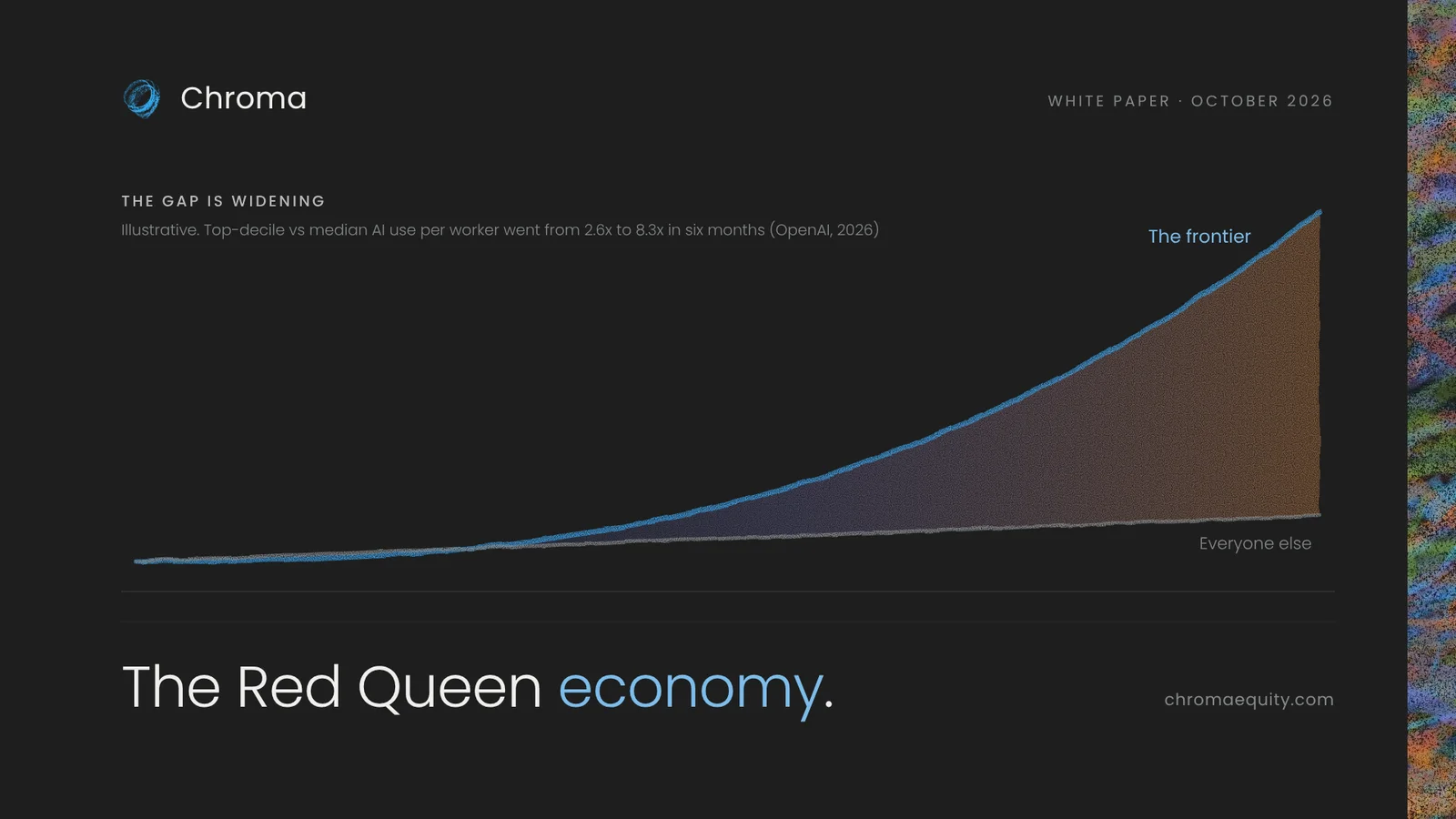
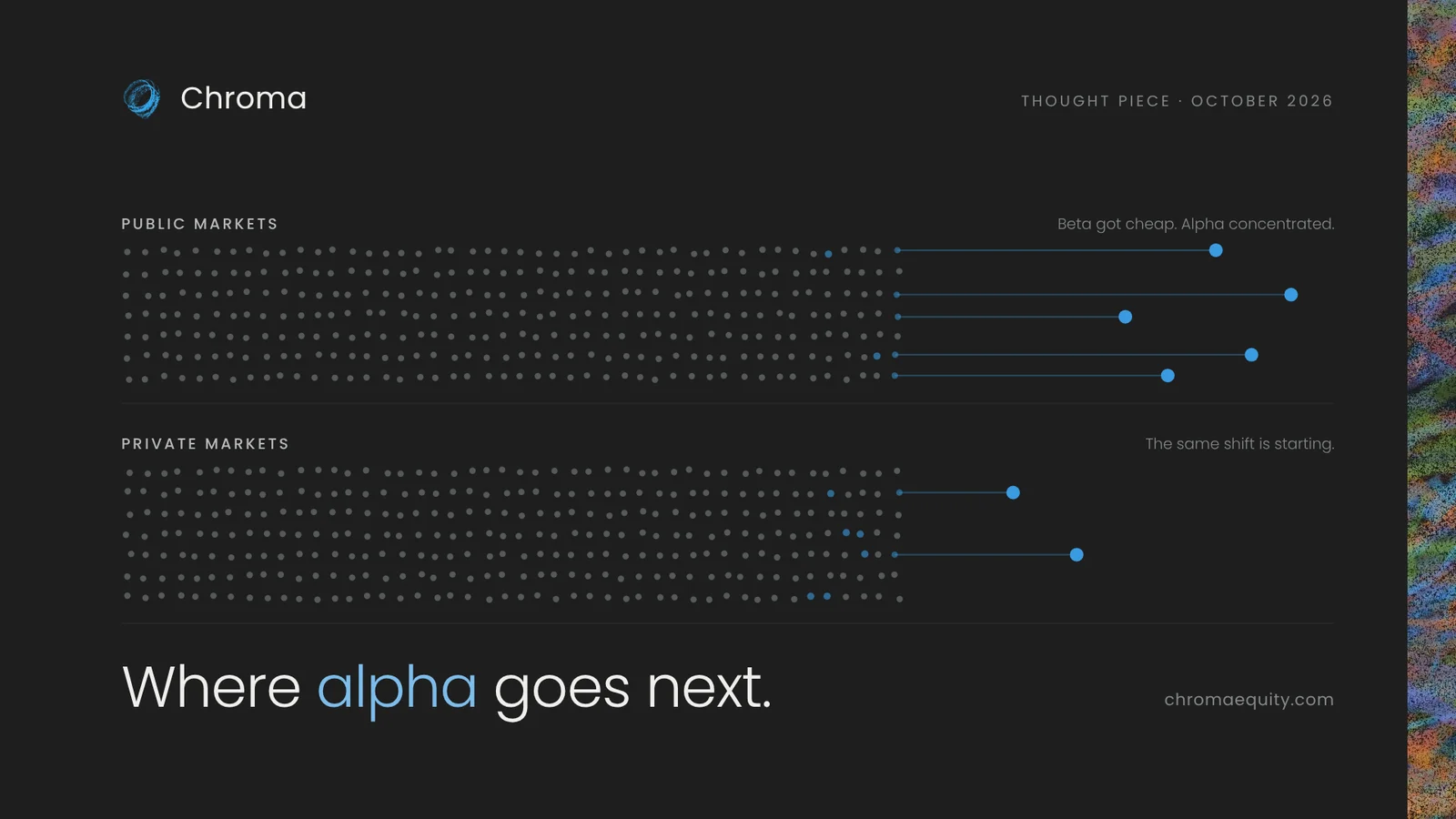
Our position. Public equity has already lived through the story private equity is now starting. Cheap market exposure took the assets, the average active manager lost, and the alpha that survived pooled in a handful of specialist firms that are small, constrained and hard to copy. We believe private equity is on the same road. Large-cap buyouts increasingly behave like an expensive way to own the market. Financial engineering has been competed away. AI is about to turn back-office cost-cutting into something every buyer can do. Private-market alpha will move to managers who are small by design, buy outside auctions and build inside the companies they own. Chroma is built to be one of them.
Public markets: a play in three acts
Act one: beta got cheap and won the assets. At the end of 2023, passive US mutual funds and ETFs held about $13.3T against $13.2T in active funds, the first time passive led. That year active funds lost about $450B to outflows while passive took in about $529B.1
Act two: the average active manager lost. Over the 15 years to 2024, 89.5% of active US large-cap funds trailed the S&P 500.2 In 2025 alone, 79% did.3 Buffett made the point with his own money: in a ten-year bet covering 2008 to 2017, an S&P 500 index fund beat a group of hedge-fund portfolios chosen by a professional manager, after fees, and not narrowly.4
Act three: the alpha that remained concentrated. The money that still pays for skill went to a few specialists. About 53 multi-manager platforms ran $366B at mid-2024, roughly 8% of a $4.5T hedge fund industry.5 In 2025, the 20 most successful managers made $115.8B for clients, about 21% of all hedge fund gains, while managing 16.6% of the assets. The list barely changed from the year before, and most of those managers limited inflows or returned capital.6
The common thread is uncomfortable for anyone selling scale. The winners are capacity-constrained by choice. They turn money away to protect returns. Alpha survived where it was hard to scale, hard to copy and paid for by structure rather than by marketing.
Private equity is in act two
Private equity's own version of beta is forming, and the easy sources of excess return are being competed away.
| Public markets | Private equity today | Evidence |
|---|---|---|
| Index funds package the market cheaply | Large-cap buyout and evergreen funds package "private markets" at scale | Evergreen funds passed $600B in June 2026, with average net expenses above 3%. PitchBook projects about $1.1T by 2030 7 |
| Assets concentrate in the largest managers | LP dollars concentrate in the largest GPs | Funds of $500M or more took about 81% of LP dollars in 2025 8 |
| The average active manager trails the index | The average PE fund struggles to beat public markets | Public markets beat the US PE index in most periods shorter than 10 years 9 |
| Information edges get arbitraged away | Leverage and multiple expansion stop doing the work | A typical deal needs 10–12% annual EBITDA growth for 2.5x, up from about 5% 10 |
| Common factors become cheap to harvest | AI cost-cutting becomes a standard playbook | Our view: a gain every buyer can capture gets priced into the entry multiple |
The size of the private universe is why this matters. US PE-backed companies grew from about 2,000 in 2000 to more than 11,500 by 2024, while listed companies fell from about 7,000 to 4,500.11 Private equity is no longer a niche you can beat simply by being in it. Being in it is increasingly just exposure.
Act three has already begun. MSCI data shows that small buyout funds have the widest gap between top- and bottom-quartile results.12 Where dispersion is widest, skill is worth the most.
AI, at the first and second level
The first-level view runs like this: AI will cut costs inside portfolio companies, so private equity returns will rise. It sounds right, and nearly everyone holds it.
The second-level view asks what happens when everyone holds it. If every buyer can capture the same savings, every seller knows it too, and the savings get priced into the entry multiple. A gain that everyone can get is not alpha. It is the new price of admission.
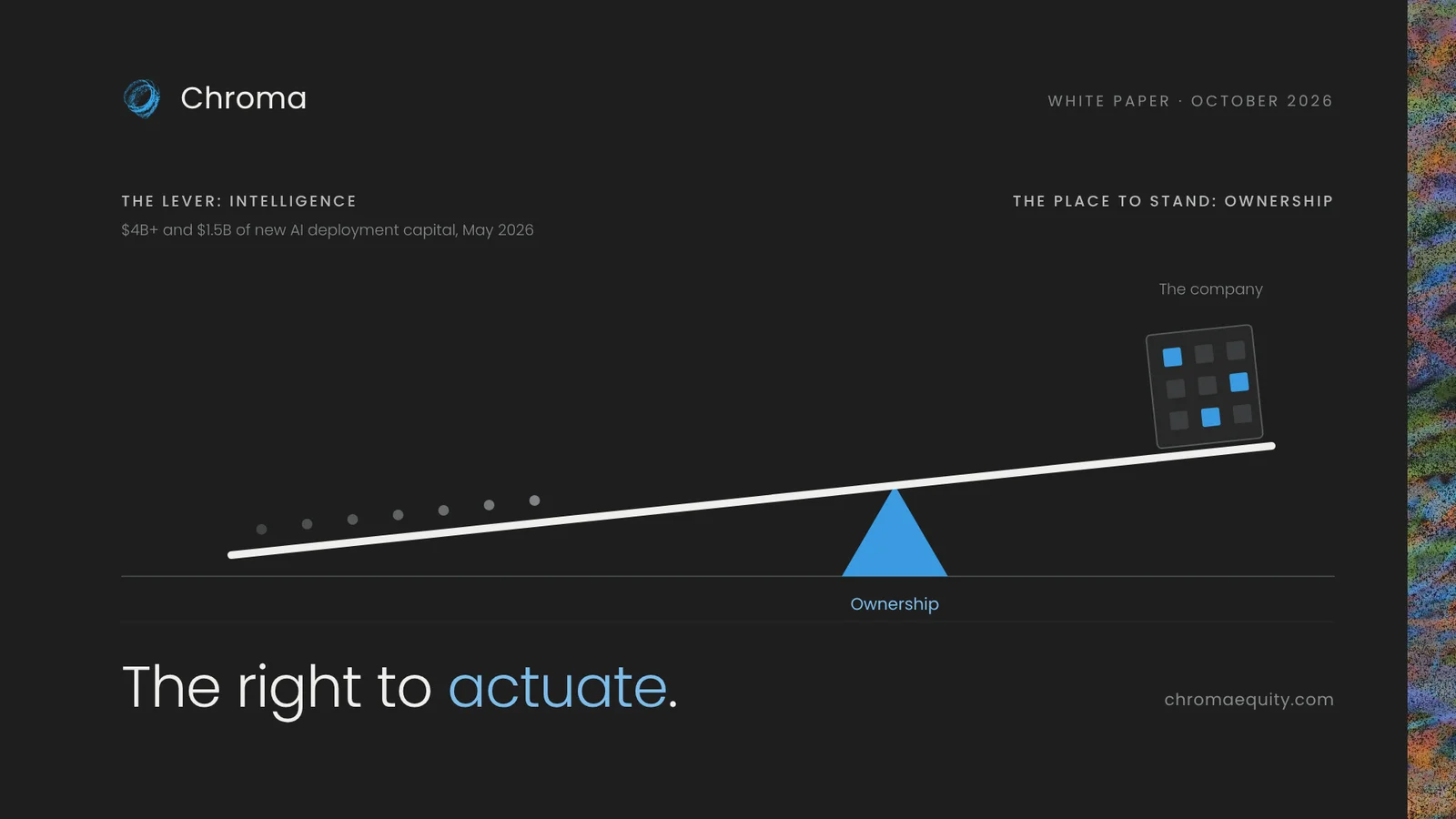
The durable edge sits in what AI cannot commoditise: who you can buy from, what you pay, and the slow, unglamorous work of installing new tools inside small, old businesses. As General Catalyst's Marc Bhargava put it, "it's really hard to transform a company with AI".13 We agree, and that difficulty is the moat.
Where private alpha will live
If private markets follow public ones, alpha will gather where the winning hedge funds found it: in managers whose edge cannot be scaled, packaged or copied. In private equity, we see five traits.
Capacity constraints. The best public managers cap their own size. In private markets the cap comes from the target. A $3M-EBITDA business cannot absorb a billion dollars, so mega-funds cannot compete for it. Lower-middle-market funds from 2010–2020 vintages earned a median net IRR of 16.1%, against 14.2% for large funds.8
Proprietary access. Auctions are the private-market index. Every bidder sees the same book and pays the same clearing price. Buying directly from owners, before a process, is the private-market version of an information edge.
Entry price. Small companies trade at lower multiples: about 6.3–6.9x EBITDA under $25M of enterprise value, against 10.0x at $100–250M.14 Growing a company from one band into the next is a return that leverage cannot copy.
Operating capability that lives in-house. Multi-manager platforms win on talent and process, not on capital. The private version is a firm whose engineers build inside each company. Anyone can hire a consultant. Nobody can hire, overnight, a standing team that has done the work before.
Idiosyncratic plans. Platforms run one playbook across dozens of companies. That is efficient, and it drifts toward the average. Alpha comes from plans specific to one company's customers, prices and gaps.
Each of these traits weakens as a manager grows. That is exactly why the alpha stays scarce, and why the firms that keep it will be the ones willing to stay small.
What we would do with a private equity budget
If we were allocating, we would split the private equity budget the way most allocators now split public equity.
Pay beta prices for beta. Large-cap buyout and evergreen products deliver broad private-market exposure. Judge them on fees, liquidity and cost of access, not on promises of outperformance.
Concentrate the alpha budget in constrained specialists. Back small managers who stay small, buy outside auctions and can show operating capability, not just capital.
Underwrite how value was created, not how it was financed. Ask how much of a track record came from revenue growth and how much from leverage and multiple expansion. "12 is the new 5" suggests the second kind won't repeat.10
Expect dispersion. Small-fund results vary widely. Manager selection matters more here than anywhere else in the portfolio.
How Chroma is built around it
| Trait | How Chroma is built |
|---|---|
| Capacity constraint | $1–10M of EBITDA, one company at a time, no roll-ups |
| Proprietary access | Direct conversations with owners, a free first session, rarely an auction |
| Entry price | Lower-middle-market valuations, with little or no debt, so leverage is not needed to make returns work |
| In-house capability | Our own engineers in every company, plus a growing bench of vertical AI partners |
| Idiosyncratic plans | A written plan for each company before signing. Growth first: sales, pricing, recurring revenue and data |
The best arguments against us
An analogy is a tool, not a proof. These are the strongest objections we have heard, and our answers.
"Scale still wins in private equity." Large firms have better data, financing and sourcing networks, and top-quartile buyout funds beat public markets over every horizon.9 Our view: agreed. Our claim is about where the average large fund is heading, not the best ones. The best large firms resemble the top hedge funds: rare, closed or hard to access.
"The small-fund edge is modest." It is. The data shows a 1.9-point median IRR advantage for lower-middle-market funds but only 0.06x on TVPI, and the edge doesn't hold on every measure.8 Our view: the median is the wrong target. The case for the segment is its dispersion. A manager with a real operating edge should land well above the median, and one without it well below.
"Private returns are hard to measure." IRRs can flatter, and marks lag. Academics such as Oxford's Ludovic Phalippou have long questioned how private equity reports performance.15 Our view: that argues for cash. Low-debt businesses can return cash during the hold, which is much harder to argue with than a mark.
"AI will make operating improvement a commodity too." Possibly, for cost. That is why we don't build the thesis on cost. If operating gains do commoditise, the edge shifts further toward access and entry price, which we are also built around.
"Concentration risk." One company at a time is concentrated by design. Our view: little or no debt limits the damage from a bad year.
Our recommendation
In public markets, the investors who saw this first stopped paying alpha fees for beta and went looking for the few managers who were small on purpose. We think private markets are about to reward the same discipline, and that the window to back those managers early is open now. We are building Chroma to be small on purpose.
— Chroma Partners