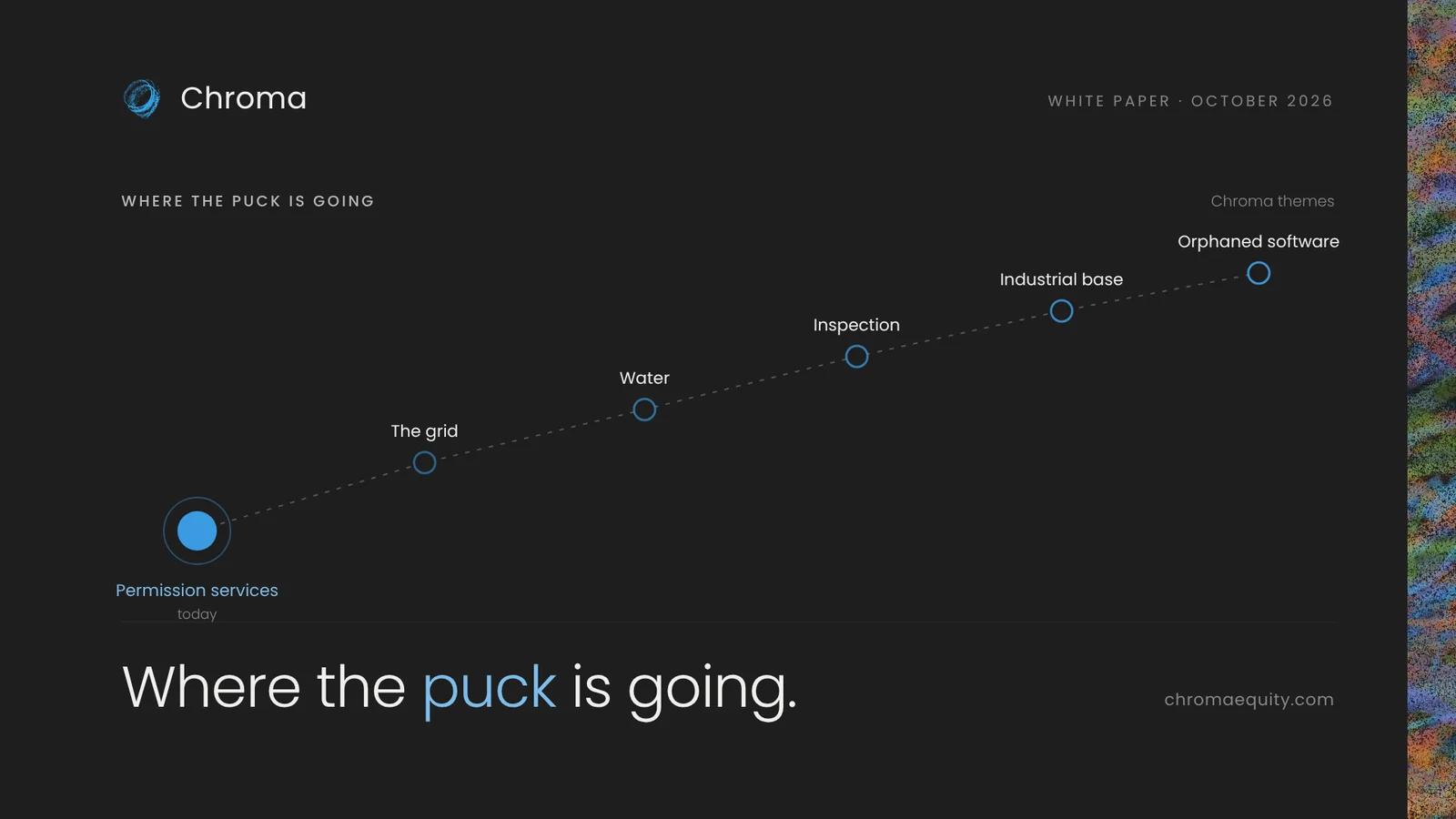
"I skate to where the puck is going to be, not where it has been."
— Wayne Gretzky
Our position. Most private equity firms pick a sector and wait for it to come to them. We think that is backwards. Sectors don't create returns. Moments do. A moment is when several forces hit the same small businesses at once: a rule changes, the skilled people retire, the owners age out, the cost of a technology collapses, and big capital looks the other way. When that happens, a business that was ordinary yesterday becomes extraordinary for whoever owns it next. Chroma is built to be opportunistic about where and disciplined about what. What we do never changes: buy good small businesses, move them from people to systems, build the commercial engine they never had, and sell them as bigger, easier-to-own companies. Where we do it follows the moment. Today, that moment is in physical services where permission, not technology, sets the pace of automation. Tomorrow it will be somewhere else. This memo names five places we think it is heading, and the signals that tell us when to move.
Specialise in a transformation, not a sector
Sector funds have obvious appeal: deep knowledge, a clear story for LPs and a known set of buyers. They also have a built-in flaw. A sector fund has to keep buying its sector even after the moment has passed, and it pays the price everyone else is paying.
We think the edge in small-company investing comes from three things that belong to no sector.
The transformation. Moving a company from people to systems, and building pricing, sales and recurring revenue, works the same way in an inspection company, a machine shop and a vertical-software business.
The moment. Returns come from buying before a shift is priced in. That requires the freedom to move to where the shift is happening.
The discipline. Every deal has to work without the catalyst. The theme improves the upside. It never carries the case.
The best compounders behaved this way. Danaher's business system started in industrial tools and later carried into life sciences.1 Constellation's playbook works across more than 100 software verticals.2 The operating system was the specialty. The sector was a choice.
Today's theme: services that need permission
The theme we are acting on now sits in physical compliance work: testing, inspection, certification and the field services behind them. Fire protection, electrical testing, corrosion, backflow and elevators.
The work is mandated. Codes require it on a schedule, whatever the economy does.
The people are leaving. Manufacturing, construction and the skilled trades see about five retirements for every two replacements, and up to 2.1 million trades jobs could go unfilled by 2030.3
The owners are leaving too. About half of US employer businesses are owned by someone 55 or older.4
Permission is starting to shift. As licensed technicians become scarce, code bodies and regulators are beginning to accept remote and automated methods for some mandated tasks in some jurisdictions. This is our observation from the field; it is uneven and early.
Why that's valuable: where a machine is allowed to take a mandated reading, a business can move from billing per visit to billing per asset. The technician stops driving to every site and starts supervising a fleet. Revenue becomes recurring and margins widen, while the incumbent still prices like a field crew. We expect this window to be open roughly from 2026 to 2030. After that, the shift will be priced in.
Tomorrow's themes
These are the places we think the next moments will form. Each has the same signature: demand that can't be put off, a shortage of people or equipment, aging owners, and small businesses that are invisible to large capital. We hold these views with conviction and without certainty, which is the only honest way to hold a forecast.
1. The grid's hidden workforce
AI needs electricity, and electricity needs small companies nobody has heard of.
Demand is surging. Data centers used about 4.4% of US electricity in 2023. The Department of Energy projects 6.7–12% by 2028.5
Equipment is scarce. New transformers can take up to three years to arrive, against four to six weeks five years earlier.6
The installed base is old. About 55% of residential transformers are near the end of their lives, and US distribution-transformer need could rise up to 260% by 2050.6
Our bet. The winners won't only be the utilities and the chipmakers. They will also be the regional firms that test, refurbish, maintain and install the equipment between the substation and the server rack. Today those are owner-run shops with no software and no sales team.
2. The water reckoning
A federal deadline has turned a century-old problem into a decade-long work order.
The scale. The EPA estimates up to 9 million lead pipes still serve US homes. Its 2024 rule requires most systems to replace them by 2037, at 10% a year.7
The money. Congress set aside $15 billion for lead-line replacement in the 2021 infrastructure law.7
Our bet. Inventory, testing, inspection and replacement services, and the labs that verify the work, will see a decade of mandated demand. The small specialists who already know the local systems will be worth far more to an owner who can give them systems and scale.
3. Inspection from the air and the sensor
America has more aging infrastructure than it has inspectors.
The backlog. About 221,800 US bridges, 36% of the total, need major repair or replacement, and 42,067 are rated poor. Addressing the identified needs would cost over $400 billion.8
Our bet. This is the permission theme's next frontier. As drones, sensors and AI inspection become acceptable to regulators, the firms that hold the inspection relationships today become the natural owners of a far more scalable, data-rich business.
4. Rebuilding the industrial base, one supplier at a time
Reshoring and defense spending need suppliers that consolidation hollowed out.
The hollowing. US aerospace and defense consolidated from 51 prime contractors to 5 since the 1990s, and the Pentagon has reported a decline in its small-business prime contractors.9
Our bet. The precision machine shops, specialty coaters and certified component makers in that supply chain are often sole sources run by founders near retirement. They are strategically vital, under-systemised and too small for anyone but a builder to own well.
5. The AI-orphaned software business
AI is repricing software built before ChatGPT. Some of it is worth more to the right owner than ever.
The repricing. Startups last funded in 2021 are worth about 68% less on average, and SaaS companies are the largest group of fallen unicorns.10 Software marks in PE portfolios fell about 8% in Q1 2026.11
Our bet. Vertical software that runs a physical industry, such as dispatching, compliance records or plant scheduling, keeps its customers even as generic SaaS gets commoditised. Bought cheaply from investors who need liquidity and rebuilt by engineers with AI, it can become the system of record for the businesses in our other themes.
How we find the next theme
We don't predict themes. We watch for convergence: two or more signals hitting the same kind of small business at the same time.
| Signal | What it looks like | Example today |
|---|---|---|
| A rule changes | A mandate, a deadline or a new permission | Lead-pipe replacement by 2037 7. Remote methods for mandated inspections |
| A shortage bites | Skilled people or critical equipment can't keep up with demand | 5 trade retirements per 2 replacements 3. Transformer lead times up to 3 years 6 |
| Owners age out | A cohort of founders with no successors | About half of employer-business owners aged 55+ 4 |
| A cost collapses | A technology becomes cheap enough for a 40-person business | AI inference down about 280-fold, 2022–2024 12 |
| Capital looks away | A category falls out of favour with large investors | Software repricing 10. Fund-held companies that can't be sold |
One signal is a trend. Two is a theme. Three or more is a moment, and that is when we move.
The discipline that keeps opportunism from becoming drift
Howard Marks's first rule is that most things will prove to be cyclical, and themes are no exception. Opportunism without discipline is just style drift with a better story. These are the rules that stop us from chasing.
The transformation never changes. If our playbook doesn't apply, the theme doesn't matter.
Every deal works without the catalyst. We underwrite on today's business. The theme is upside, never the base case.
Same size, same structure. $1–10M of EBITDA, majority ownership, little or no debt. No exceptions for a hot theme.
No AI for its own sake. We buy the business first. We avoid businesses whose product is white-collar work that AI will replace, because we would be buying the disruption, not the opportunity.
Themes have expiry dates. Each one gets a window and a kill test. When a theme is priced in, we stop sourcing it.
No roll-ups to chase a theme. One company at a time, even when a sector is hot.
What we don't know
We don't know which of these five themes will mature first, how quickly regulators will accept new methods, or whether some will be priced in before we arrive. Being early is a cost; being too early is the same as being wrong. That is why we underwrite each company on the business it is today and treat the theme as a free option, not a promise.
Why Chroma
Most firms are built around what they already know. Chroma is built around what doesn't change, so that it can go where the change is.
A transferable operating system. Our engineers' playbook works across inspection firms, machine shops and vertical software alike.
A bench that travels. Our vertical AI partners cover jobs every small business has: answering the phone, selling, billing and collecting. They come with us into each new theme.
Two doors into every theme. Founder successions, and the fund-owned orphans that big sponsors and venture firms can't sell.
Capital that can move. No debt dependence and no sector mandate mean we can act on a moment when it arrives.
A thesis that admits it will change. We would rather be early to the next moment than loyal to the last one.
The firms that defined private equity's last era were built on cheap debt. We think the firms that define the next one will be built on knowing where the puck is going, and on having the operating skill to be there first. That is the firm we are building.
— Chroma Partners